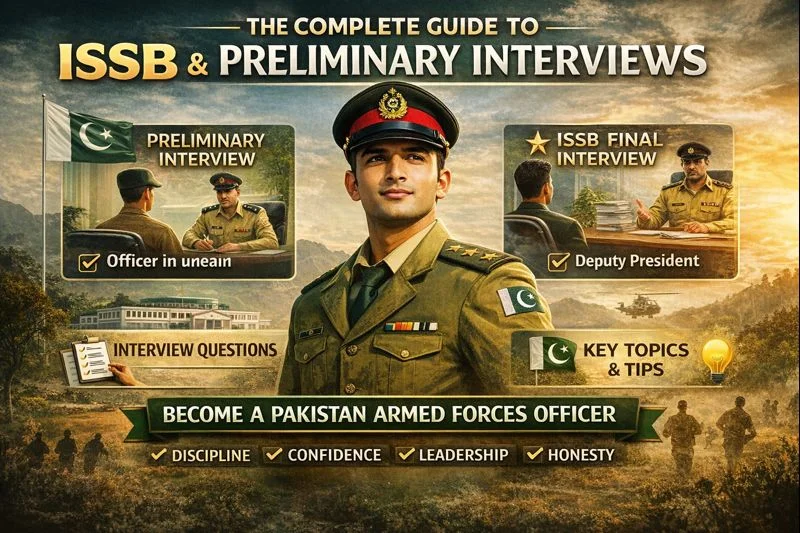
Joining the Pakistan Armed Forces is not only about physical strength or academic performance. The selection process is designed to identify individuals with the personality, discipline, emotional stability, and leadership potential required for a demanding military career.
The first real assessment of a candidate’s personality begins at the Preliminary Interview (AS&RC) and reaches its peak during the ISSB Final Interview. While written tests evaluate knowledge and reasoning, interviews evaluate character.
This article provides a clear and professional explanation of:
-
The structure of AS&RC and ISSB interviews
-
What officers actually assess
-
Common question areas
-
Psychological expectations
-
Key Islamic and Pakistan Studies topics
-
Practical strategies to perform confidently
Part I: Preliminary Interview at AS&RC
Purpose of the Preliminary Interview
The AS&RC interview is a short but critical screening stage. Its purpose is to decide whether a candidate is suitable to be sent to ISSB.
During this interview, the officer evaluates:
-
Communication skills
-
Confidence and composure
-
Basic general knowledge
-
Motivation for joining the Armed Forces
-
Consistency between academics and personality
Duration and Nature
-
Duration: 5–10 minutes
-
Style: Fast, direct, and focused
Because of the short time, first impressions and clarity matter significantly.
Common Areas of Questions
1. Personal Introduction
Candidates are usually asked to introduce themselves briefly, covering:
-
Name and hometown
-
Family background
-
Education
-
Hobbies or interests
The aim is to assess confidence, honesty, and self-awareness.
2. Education and Academic Background
Questions may include:
-
Reasons for strong or weak academic performance
-
Favourite and difficult subjects
-
Academic goals
Officers are more interested in attitude toward learning than marks alone.
3. Armed Forces Awareness
Typical questions:
-
Why do you want to join the Army, Navy, or Air Force?
-
What do you know about your selected course?
-
What is your alternate plan if you are not selected?
These questions assess seriousness and realism.
4. General Knowledge
Basic awareness is expected regarding:
-
National leadership
-
Important events
-
Simple Islamic and historical facts
5. Psychological Observation
Throughout the interview, the officer silently observes:
-
Body language
-
Eye contact
-
Calmness under pressure
-
Honesty
Hesitation, overconfidence, or memorized answers are easily noticed.
Part II: ISSB Final Interview
Importance of the ISSB Interview
The ISSB interview is the most decisive stage of the entire selection process. Conducted by the Deputy President (DP), it integrates findings from psychological tests and GTO tasks to form a complete personality profile.
Duration
-
20–30 minutes, depending on the candidate
Key Areas Assessed
1. Personality Structure
The officer evaluates:
-
Emotional stability
-
Maturity
-
Balance in behavior
-
Awareness of strengths and weaknesses
Your answers are matched with psychological test results for consistency.
2. Family and Social Background
Questions may cover:
-
Father’s profession
-
Family environment
-
Discipline at home
-
Key influences in life
The purpose is to understand the environment that shaped your personality.
3. Education and Learning Attitude
Focus areas include:
-
Academic strengths and weaknesses
-
Handling failure
-
Problem-solving approach
-
Willingness to learn
4. Motivation for Armed Forces
Candidates must demonstrate:
-
Clear purpose
-
Understanding of training demands
-
Awareness of responsibilities and sacrifices
Superficial or emotional answers without logic are usually rejected.
5. Stress and Situational Questions
This is one of the most important segments. Officers test:
-
Presence of mind
-
Moral judgment
-
Integrity
-
Emotional control
Examples include:
-
Why should we select you?
-
Why should we not select you?
-
What is your biggest failure?
-
How would you respond to an unethical order?
-
What would you do if you are not selected?
The officer evaluates how you think, not just what you say.
Part III: Frequently Asked Islamic Knowledge Areas
Candidates are often expected to know basic Islamic history.
Major Ghazwat
-
Badr — 2 AH
-
Uhud — 3 AH
-
Khandaq — 5 AH
-
Khyber — 7 AH
-
Fath-e-Makkah — 8 AH
-
Tabuk — 9 AH
Important Pacts
-
Misaq-e-Madinah — 1 AH
-
Treaty of Hudaibiya — 6 AH
-
Hilf-ul-Fudul — Before Prophethood
-
First & Second Bay‘at-e-Aqaba — 621 / 622 CE
Part IV: Pakistan Studies Essentials
Pre-Partition
-
War of Independence — 1857
-
Aligarh Movement — 1864
-
Muslim League — 1906
-
Lucknow Pact — 1916
-
Nehru Report & 14 Points — 1928–29
-
Pakistan Resolution — 23 March 1940
Post-Partition
-
Objectives Resolution — 1949
-
Constitution — 1956 and 1973
-
Indus Waters Treaty — 1960
-
Indo-Pak Wars — 1965, 1971
-
Nuclear Tests — 28 May 1998
Part V: How to Perform Well in the Interview
-
Speak clearly and naturally
-
Avoid memorized or exaggerated answers
-
Maintain natural eye contact
-
Stay calm under pressure
-
Structure answers logically
-
Be honest and realistic
Confidence with humility leaves the strongest impression.
Sample Answer Frameworks
“Tell me about yourself”
A good answer is short, structured, and relevant.
“Why do you want to join the Armed Forces?”
Focus on discipline, responsibility, service, and long-term commitment rather than emotion alone.
Frequently Asked Questions (FAQs)
Is English fluency mandatory?
Clear expression matters more than accent or advanced vocabulary.
Are stress questions meant to trap candidates?
No. They test emotional stability and logical thinking.
Is memorization helpful?
Over-memorization often harms performance.
Does background matter more than personality?
Personality and behavior matter far more than background.
Conclusion
The AS&RC and ISSB interviews are designed to evaluate who you are, not who you pretend to be. They assess discipline, clarity of thought, emotional balance, honesty, and leadership potential.
Success does not come from memorized answers, but from:
-
Self-awareness
-
Mental readiness
-
Consistency
-
Calm behavior under pressure
Candidates who understand the interview system and present their real personality with confidence stand the best chance of earning the honour of serving Pakistan in uniform.