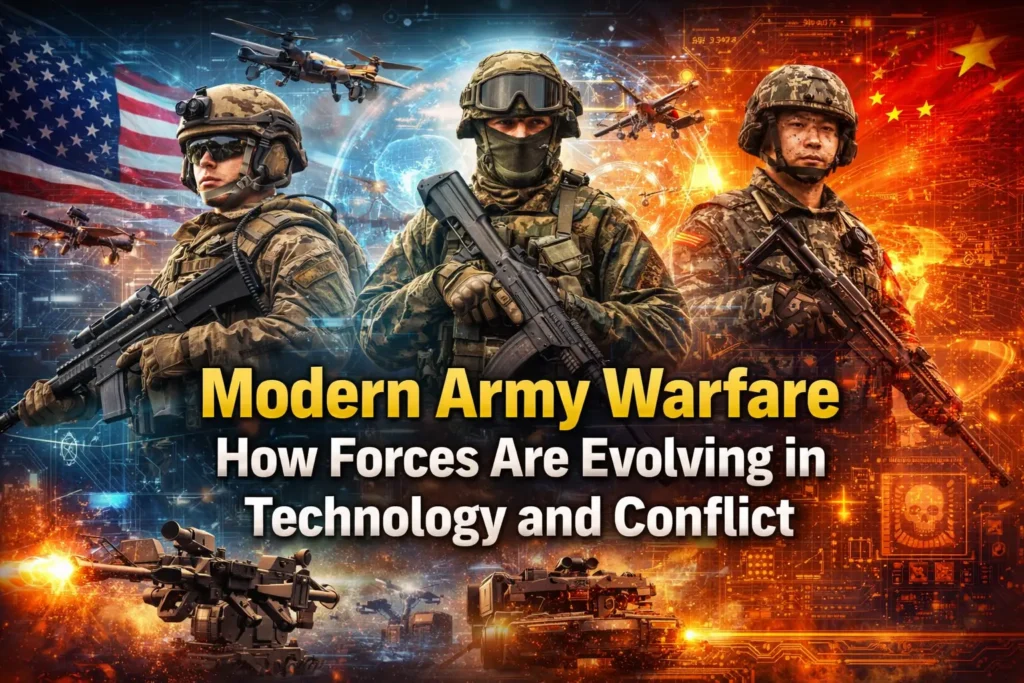
The concept of an army has changed dramatically over the past decade. Gone are the days when warfare was defined only by tanks, infantry, and air strikes. Today, armies are transforming into highly integrated, technology-driven forces capable of fighting across multiple domains at once.
From cyber warfare units to drone swarms and artificial intelligence-based targeting systems, modern forces are being reshaped in ways that were unimaginable just a few years ago.
But the real question is not just how armies are evolving. It is why they are evolving at such a rapid pace, and what this means for future conflicts.
The Shift from Traditional Armies to Multi-Domain Forces
Modern armies are no longer limited to land operations. They now operate across multiple domains simultaneously.
Key Domains of Modern Warfare
- Land operations with mechanized and infantry units
- Air superiority through advanced fighter jets and drones
- Naval power controlling strategic waterways
- Cyber warfare targeting communication and infrastructure
- Space-based systems for surveillance and navigation
This integration allows forces to operate faster, smarter, and with greater precision.
The Rise of Technology in Modern Armies
Technology is now the backbone of every serious military force.
1. Drone Warfare
Drones have become one of the most decisive tools on the battlefield.
- Surveillance drones provide real-time intelligence
- Combat drones can strike targets with precision
- Swarm technology is changing how battles are fought
Even smaller nations can now challenge stronger armies using drone tactics.
2. Artificial Intelligence in Warfare
Artificial intelligence is no longer experimental. It is operational.
- AI-assisted targeting systems
- Automated threat detection
- Decision-support systems for commanders
This reduces human error and speeds up response time.
3. Cyber Warfare Capabilities
Modern conflicts often begin in cyberspace before physical engagement.
- Attacks on power grids and communication networks
- Disruption of military command systems
- Information warfare influencing public opinion
Cyber units are now as important as combat units.
Training of Modern Soldiers: Beyond Physical Strength
The role of a soldier has evolved significantly.
New Training Focus Areas
- Digital awareness and cyber defense basics
- Operating advanced equipment and drones
- Urban warfare and close-quarter combat
- Psychological resilience under constant threat
Today’s soldier must be both physically strong and mentally sharp.
Hybrid Warfare: The New Battlefield Reality
Modern wars are rarely fought in a single dimension. They combine multiple strategies.
Elements of Hybrid Warfare
- Conventional military operations
- Irregular tactics using proxy groups
- Cyber attacks and misinformation campaigns
- Economic pressure and sanctions
This approach makes conflicts more complex and harder to predict.
Global Army Modernization: Who Is Leading?
Several countries are investing heavily in military modernization.
United States
- Focus on advanced technology and global reach
- Strong investment in AI and cyber capabilities
China
- Rapid expansion of military power
- Emphasis on regional dominance and naval strength
Russia
- Experience in hybrid warfare
- Focus on missile systems and electronic warfare
Emerging Powers
Countries like Turkey, Iran, and India are also modernizing rapidly, focusing on self-reliance and indigenous systems.
Challenges Facing Modern Armies
Despite advancements, modern forces face serious challenges.
1. High Cost of Technology
Advanced systems are expensive to develop and maintain.
2. Dependence on Digital Systems
Heavy reliance on technology makes armies vulnerable to cyber attacks.
3. Complexity of Coordination
Multi-domain operations require precise coordination, which is difficult under pressure.
What Future Wars Will Look Like
Future conflicts will not follow traditional patterns.
Key Characteristics
- Faster decision-making cycles
- Increased use of unmanned systems
- Limited direct confrontation between major powers
- Greater focus on economic and cyber pressure
Wars may start silently and escalate rapidly.
What Comes Next: A Strategic Outlook
Looking ahead, armies will continue to evolve in three key directions.
1. Automation
More reliance on autonomous systems and robotics.
2. Intelligence Dominance
Winning wars through better information, not just firepower.
3. Network-Centric Warfare
All units connected through real-time data systems.
Key Takeaways
- Modern armies are becoming technology-driven and multi-domain
- Drone and cyber warfare are reshaping battlefields
- Soldiers are being trained for both physical and digital combat
- Future wars will be faster, smarter, and more complex
FAQs
1. What is modern warfare?
Modern warfare involves the integration of technology, cyber operations, and traditional military power across multiple domains.
2. Why are drones so important today?
Drones provide cost-effective surveillance and precision strike capabilities, making them essential in modern conflicts.
3. Can cyber warfare replace traditional warfare?
Not entirely, but it plays a critical role in weakening the enemy before physical conflict begins.
4. Are armies becoming fully automated?
Not completely, but automation and AI are increasingly being integrated into military systems.
Conclusion
The evolution of modern armies is not just a technological shift. It is a complete transformation of how wars are planned, fought, and even avoided.
Armies today are preparing for conflicts that may not even look like wars in the traditional sense. The battlefield is expanding beyond physical borders into cyberspace, information networks, and even economic systems.
The future soldier will not just carry a weapon. He will carry data, intelligence, and the responsibility of operating in a world where the line between war and peace is becoming increasingly blurred.
And that is where the real challenge lies.
Because the next war may not begin with an explosion.
It may begin with a signal.