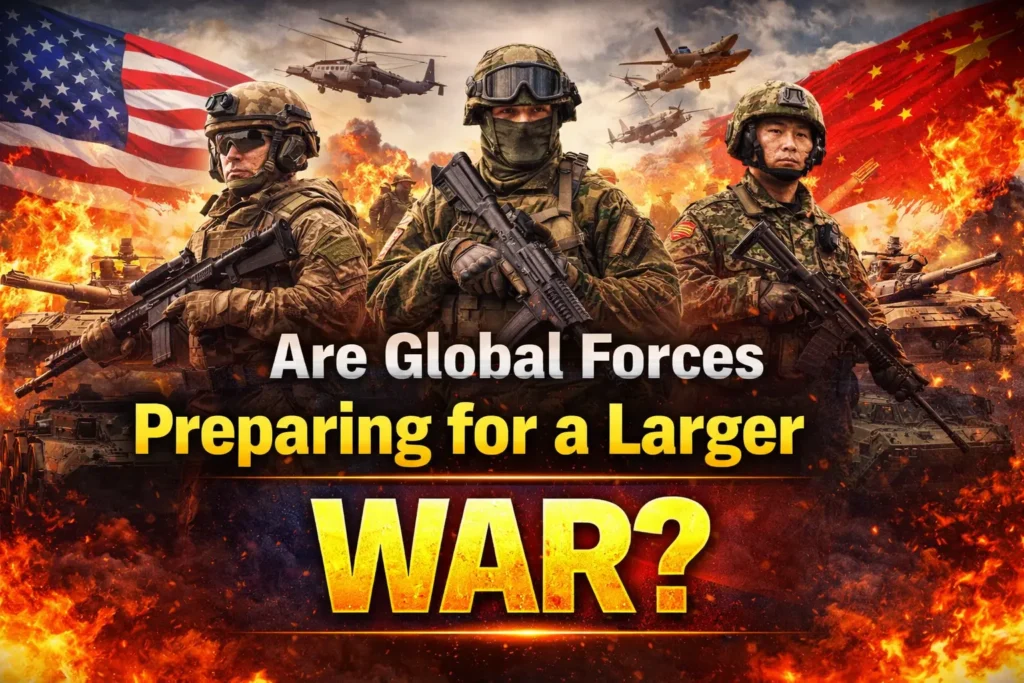
Across the world, armies are moving, training cycles are intensifying, and defense budgets are rising at a pace not seen in years. From Eastern Europe to the Middle East and the Indo-Pacific, military forces are no longer operating in routine mode. They are shifting toward something more serious.
The question many are now asking is simple but critical. Are global forces preparing for a major war, or is this just strategic signaling?
This is not about headlines or political statements. This is about ground reality. Troop movements, training patterns, weapons deployment, and the psychology of modern armies.
Let’s break it down in detail.
The Changing Nature of Modern Armies
Modern armies are no longer built only for conventional war. They are designed for multi-domain operations.
Key Transformations
- Integration of cyber warfare units
- Increased reliance on drones and AI-based systems
- Rapid deployment forces replacing static formations
- Real-time intelligence and surveillance systems
Armies today are not just preparing for battlefields. They are preparing for networks, satellites, and digital space.
Why Global Forces Are on High Alert
There is not one single reason. It is a combination of overlapping crises.
1. Multiple Conflict Zones
- Ukraine war continues to reshape military thinking
- Middle East tensions remain volatile
- South China Sea is becoming increasingly contested
Each region is influencing how armies prepare.
2. Shift Toward Great Power Competition
The world is moving away from a unipolar structure.
- The United States is reinforcing alliances
- China is expanding military reach
- Russia is asserting itself through prolonged conflict
This creates a constant state of strategic competition.
3. Lessons from Recent Wars
Recent conflicts have changed military doctrine.
- Drones can neutralize expensive equipment
- Logistics and supply chains are decisive
- Information warfare shapes global perception
Armies are adapting fast.
Army Readiness: What Does It Really Mean?
When we say armies are preparing, what does that actually involve?
1. Training Intensification
- Large-scale military exercises
- Joint drills between allied forces
- Simulation of real combat scenarios
Training is no longer symbolic. It is realistic and aggressive.
2. Equipment Modernization
- Upgrading tanks, artillery, and missile systems
- Introducing unmanned systems
- Enhancing air defense capabilities
Armies are investing in survivability and precision.
3. Rapid Mobilization Capability
- Faster troop deployment systems
- Pre-positioned equipment in strategic locations
- Logistics networks designed for quick response
Speed is now as important as strength.
Ground Reality: What Soldiers Are Experiencing
At the soldier level, the shift is very clear.
- Increased operational tempo
- More frequent field exercises
- Exposure to hybrid warfare training
- Psychological pressure of uncertain conflict
Modern soldiers are not just fighters. They are being trained as multi-role operators.
Key Regions Where Army Activity Is Rising
Eastern Europe
Armies are reinforcing positions, conducting NATO exercises, and preparing for potential escalation.
Middle East
Forces are on alert due to ongoing tensions and proxy conflicts.
Asia-Pacific
Military build-up is visible as countries prepare for long-term strategic competition.
Is This Preparation for War or Just Deterrence?
This is the most important question.
Deterrence Perspective
- Strong military presence prevents war
- Shows readiness without actual intent to fight
- Sends a message to adversaries
War Preparation Perspective
- Continuous buildup can lead to miscalculation
- Increased readiness lowers the threshold for conflict
- Accidental escalation becomes more likely
The truth lies somewhere in between.
What Could Trigger a Large-Scale Conflict?
Even with preparation, war is not automatic. But certain triggers can change everything.
1. Direct Clash Between Major Powers
Any direct military confrontation between global powers can escalate rapidly.
2. Regional Conflict Spreading
A local conflict expanding beyond its borders.
3. Misinterpretation of Military Moves
One side’s defensive action seen as offensive by another.
4. Political Decisions
Ultimately, wars are decided by leadership choices.
What Happens If War Breaks Out?
If a large-scale war begins, it will not look like past wars.
Key Features
- Multi-front operations
- Cyberattacks targeting infrastructure
- Use of advanced missile systems
- Information warfare shaping narratives
This would be a complex, high-speed conflict.
What to Expect Next: A Realistic Outlook
Looking ahead, the situation is tense but controlled.
Most Likely Scenario
- Continued military buildup
- Regular exercises and force demonstrations
- No immediate large-scale war
Medium Risk Scenario
- Limited regional conflicts
- Controlled escalation
High Risk Scenario
- Rapid escalation due to a triggering event
Key Takeaways
- Global armies are clearly increasing readiness
- Modern warfare is multi-domain and technology-driven
- Deterrence and preparation are happening simultaneously
- The risk of miscalculation is the biggest danger
FAQs
1. Are global armies preparing for World War III?
Not directly, but they are preparing for high-intensity conflict scenarios which could escalate if mismanaged.
2. Why is military training increasing worldwide?
Because modern threats are evolving, and armies need to adapt quickly to new forms of warfare.
3. Is deterrence effective?
Yes, strong military presence can prevent war, but it also carries risks if misinterpreted.
4. What role do soldiers play in modern warfare?
Soldiers are now trained in multiple domains, including cyber awareness, intelligence, and advanced weapons systems.
Conclusion
The world is entering a phase where military readiness is becoming the norm, not the exception. Armies are training harder, deploying faster, and thinking differently.
This does not mean war is inevitable.
But it does mean that the margin for error is shrinking.
The next conflict, if it happens, will not come as a surprise. The signs are already there. The real question is whether global leadership can manage these tensions, or whether the momentum of military preparation will eventually lead to confrontation.
For now, armies stand ready.
And sometimes, readiness itself is the most powerful signal of all.