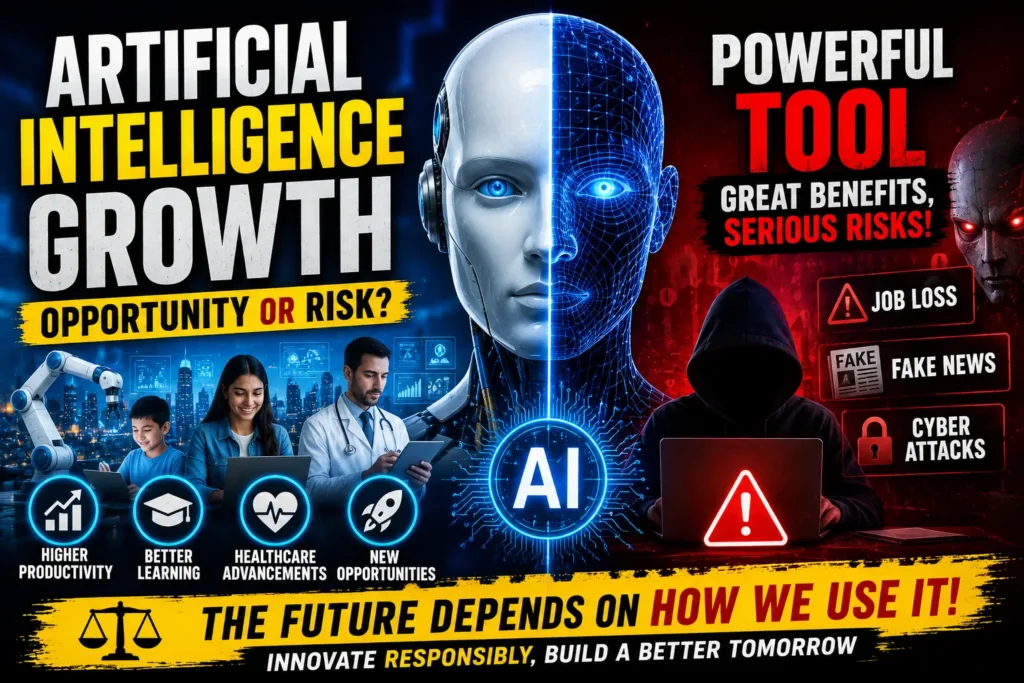
Artificial Intelligence is growing faster than ever, and it is no longer just a futuristic idea. It is already part of everyday life. From smart assistants on phones to advanced tools used by companies, AI is transforming how people work, learn, and communicate. Whether someone realizes it or not, they are interacting with AI almost daily.
Businesses are rapidly adopting AI to improve productivity and reduce costs. Tasks that once took hours can now be completed in minutes. Customer support is handled by chatbots, data is analyzed instantly, and decisions are becoming more data-driven. This shift is not small. It is changing entire industries.
At the same time, people are starting to ask an important question. Is AI an opportunity that will improve lives, or is it a risk that could create serious problems. The answer is not simple. It depends on how this powerful technology is used.
How AI Is Creating New Opportunities
One of the biggest advantages of AI is efficiency. It allows businesses to work faster and smarter. Companies can automate repetitive tasks, reduce human error, and focus more on creativity and strategy. This leads to better results and higher productivity.
In education, AI is making learning more accessible and personalized. Students can use AI tools to understand complex topics, get instant feedback, and learn at their own pace. This is especially helpful for those who struggle with traditional learning methods.
Healthcare is another area where AI is making a huge impact. Doctors can use AI-powered systems to detect diseases earlier, analyze medical data more accurately, and improve patient care. This can save lives and reduce healthcare costs.
Even small businesses and freelancers are benefiting from AI. Tools for writing, design, marketing, and automation are making it easier for individuals to compete in the market. AI is not just helping big companies. It is opening doors for everyone.
The Risk of Job Loss and Economic Impact
While AI brings many benefits, it also creates fear, especially when it comes to jobs. Many tasks that humans used to perform are now being handled by machines. This includes data entry, customer service, and even some creative work.
For workers, this can be worrying. The fear of losing a job to a machine is real. As companies focus on efficiency, they may reduce their workforce. This can lead to unemployment and economic pressure for many families.
However, it is important to understand the full picture. While some jobs may disappear, new ones will also be created. AI needs people to develop, manage, and improve it. Roles in technology, data analysis, and AI management are growing rapidly.
The challenge is adaptation. People need to learn new skills and stay updated. Those who adapt will find opportunities, while those who resist change may struggle.
Misuse of AI and Growing Concerns
Another major concern is misuse. AI is a powerful tool, and like any tool, it can be used in both good and bad ways. One of the biggest issues is the spread of fake content.
AI can generate realistic images, videos, and text that look completely real but are not true. This can be used to spread misinformation, manipulate opinions, and create confusion. In today’s digital world, this is a serious problem.
Cybersecurity is another concern. AI can be used to create advanced cyber attacks that are harder to detect and stop. This puts individuals, businesses, and even governments at risk.
There are also ethical concerns. Questions like who controls AI, how data is used, and whether AI decisions are fair are becoming more important. These issues need clear answers.
Role of Governments and Regulations
As AI continues to grow, governments around the world are working on regulations. The goal is to control risks while still allowing innovation. This is not easy, because technology is moving faster than laws.
Governments want to ensure that AI is used responsibly. They are focusing on data privacy, security, and ethical use. Regulations may include rules about how AI systems are developed, tested, and used.
At the same time, too many restrictions can slow down progress. So there must be a balance. The challenge is to create rules that protect people without stopping innovation.
Companies also have a responsibility. They must use AI ethically and ensure that their systems are safe and fair.
The Future of Artificial Intelligence
The future of AI is both exciting and uncertain. It has the potential to solve some of the world’s biggest problems, from healthcare to climate change. At the same time, it can create new challenges if not managed properly.
AI will likely become even more advanced. It may handle more complex tasks, understand human emotions better, and become deeply integrated into daily life. This will change how people work, communicate, and live.
The key factor will be human control. AI should be used as a tool to support humans, not replace them completely. With the right approach, it can improve quality of life and create new opportunities.
Conclusion
Artificial Intelligence is changing the world very fast. It offers huge benefits but also comes with risks. The key is balance. If used wisely, AI can improve productivity, innovation, and quality of life. If misused, it can create serious challenges like job loss, misinformation, and security threats.
Both governments and individuals need to understand this technology and adapt to it. Learning new skills, staying informed, and using AI responsibly will be important in the coming years.
AI is not just the future. It is the present. How we use it today will decide what tomorrow looks like.
FAQs
What is AI in simple words?
It is technology that allows machines to think, learn, and perform tasks like humans.
Will AI replace human jobs?
Some jobs may be replaced, but new opportunities will also be created.
Is AI safe to use?
Yes, if it is used responsibly and with proper rules and security.
Why is AI growing so fast?
Because businesses and industries need faster and more efficient solutions.
Can students benefit from AI?
Yes, AI helps in learning, research, and improving productivity.