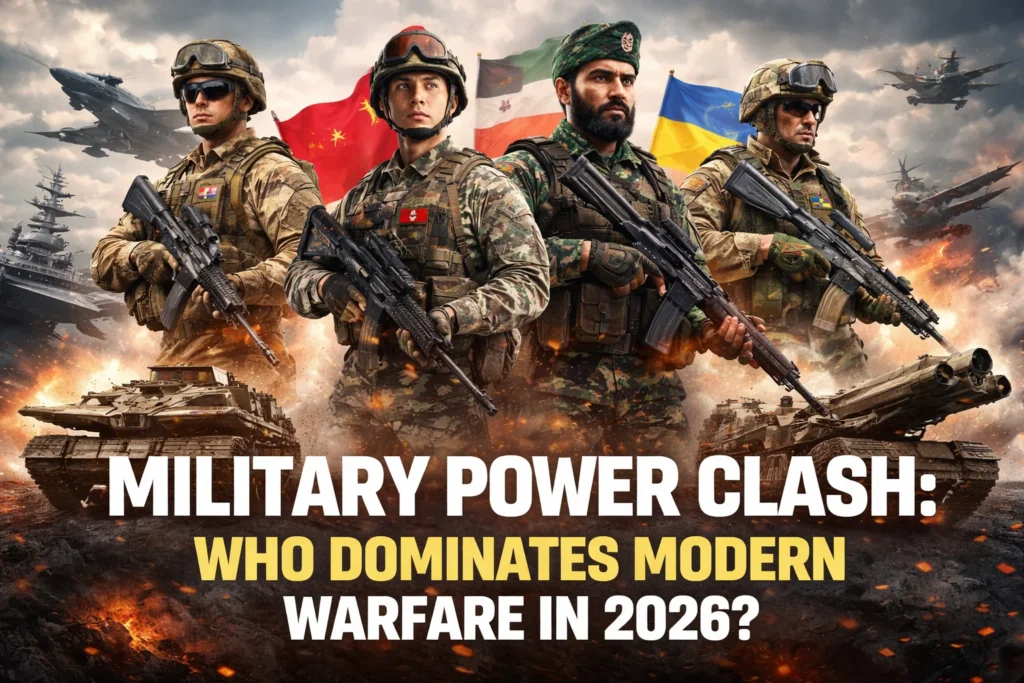
In today’s fast-changing world, military strength is no longer just about the number of soldiers or tanks. It’s about technology, strategy, global influence, and the ability to respond quickly in unpredictable situations. When we compare forces like the USA, China, Iran, and Ukraine, the conversation becomes even more interesting. Each country has built its military power in a different way, shaped by its goals, geography, and experience.
This article takes a realistic, human perspective cutting through hype to understand which military force truly stands out in 2026.
What Defines Military Power Today?
Before comparing countries, it’s important to understand what “military power” actually means today. It’s not just about size anymore. Modern warfare depends on:
- Advanced technology (AI, drones, cyber warfare)
- Air and naval dominance
- Nuclear capabilities
- Training and discipline
- Real battlefield experience
- Defense budget and logistics
A country might have millions of soldiers, but without modern systems, it cannot compete with a smaller, more advanced force.
United States: Still the Global Military Leader
The United States remains the most powerful military force in the world and that’s not just a headline, it’s reality on multiple levels.
With the largest defense budget globally, the U.S. invests heavily in cutting-edge technologies like stealth aircraft, aircraft carriers, space defense systems, and AI-driven warfare. Its global presence is unmatched, with military bases spread across continents.
What makes the U.S. stand out is not just power, but flexibility. It can operate in air, sea, land, cyber, and space domains simultaneously. From fighter jets like the F-35 to nuclear submarines, the U.S. has a complete, well-balanced military system.
Personal insight: If you look at modern conflicts, the U.S. doesn’t just fight wars it shapes them. Its intelligence systems and global alliances make it extremely difficult to challenge directly.
China: The Rising Superpower
China has rapidly transformed its military into a modern, tech-driven force. Over the past decade, it has focused on innovation, naval expansion, and missile systems.
Its navy is now one of the largest in the world, and it continues to develop hypersonic weapons and cyber warfare capabilities. China’s strategy is clear: reduce the gap with the U.S. and eventually surpass it in key areas.
However, one major limitation is real combat experience. Unlike the U.S., China hasn’t been involved in major wars recently.
Personal insight: China is like a fast-growing competitor strong, ambitious, and improving quickly. But in a real battlefield scenario, experience still matters, and that’s where it slightly lags.
Iran: Strong in Asymmetric Warfare
Iran’s military strategy is very different from the U.S. or China. Instead of focusing on global dominance, Iran specializes in asymmetric warfare meaning it uses unconventional methods to counter stronger opponents.
Its strengths include:
- Missile technology
- Proxy forces and regional influence
- Naval tactics in narrow waterways (like the Strait of Hormuz)
Iran may not match the U.S. or China in overall power, but it’s highly effective in regional conflicts and defensive strategies.
Personal insight: Iran is not built to win global wars but it’s extremely difficult to defeat in its own region. It plays smart, not big.
Ukraine: Battle-Tested and Adaptive
Ukraine has become one of the most battle-experienced militaries in recent years. Since the ongoing conflict with Russia, its forces have adapted quickly, using modern Western weapons, drones, and real-time intelligence.
Ukraine’s biggest strength is not size it’s resilience and innovation. Its soldiers are trained under real combat pressure, making them highly effective in modern warfare conditions.
Personal insight: Ukraine proves that motivation and smart tactics can challenge even larger forces. It may not be the strongest globally, but it’s one of the toughest right now.
Key Comparison: Who Stands Out?
If we compare these forces based on overall capability:
- USA → Most powerful and technologically advanced
- China → Fastest growing and future competitor
- Iran → Strong regional and unconventional force
- Ukraine → Highly experienced and adaptive
There is no single “perfect” military. Each country is strong in its own way, depending on the type of conflict.
Modern Warfare Trends in 2026
Military strategies are changing fast. Some key trends include:
- Drone warfare becoming central to operations
- Cyber attacks replacing traditional battles in some cases
- AI and automation reducing human involvement
- Hybrid warfare (mix of conventional + cyber + psychological tactics)
This means future wars may look very different from the past.
FAQs
1. Which country has the strongest military in 2026?
The United States is still considered the strongest due to its advanced technology, global presence, and massive defense budget.
2. Is China stronger than the USA?
Not yet overall, but China is rapidly growing and competing in areas like naval power and missile technology.
3. Why is Ukraine considered strong despite its size?
Because of its real combat experience, modern tactics, and strong international support.
4. Can Iran compete with global powers?
Iran cannot match them globally but is very strong in regional and asymmetric warfare.
5. What matters more today: size or technology?
Technology matters more. A smaller, advanced military can outperform a larger outdated one.
Conclusion
When people ask, “Who is the strongest?” the answer isn’t as simple as naming one country. The United States leads in overall military power, China is closing the gap, Iran dominates in regional strategy, and Ukraine shows the power of resilience and adaptability.
From a realistic point of view, modern warfare is no longer about brute force it’s about intelligence, speed, and precision. The countries that adapt fastest to new technologies and strategies will shape the future of global power.
In my view, the real winner in 2026 isn’t just the strongest military it’s the one that understands how modern war actually works.