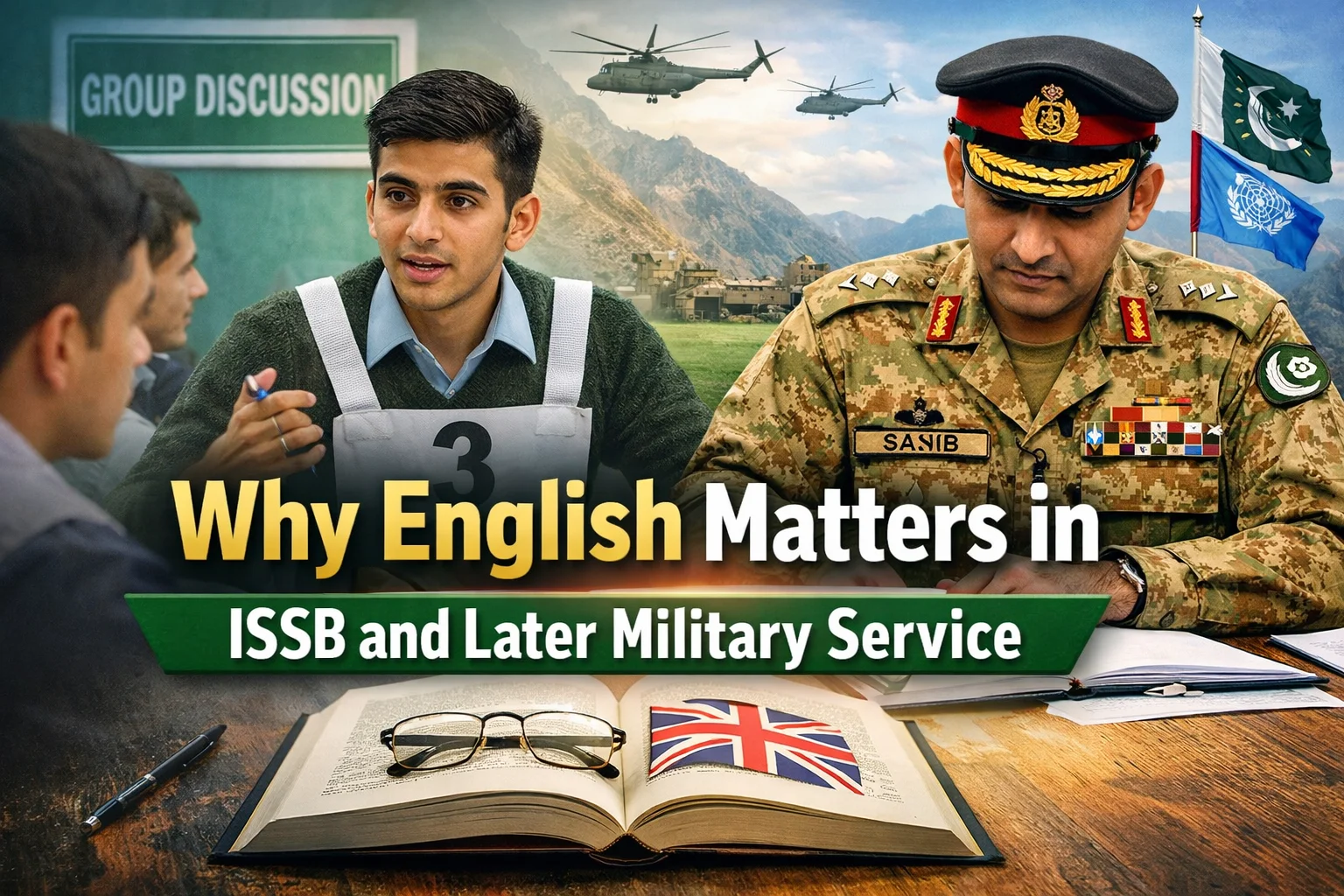
For every young man or woman who dreams of becoming an officer in the Pakistan Armed Forces, there is one skill that quietly influences the entire journey — English proficiency.
Many candidates believe that physical fitness, intelligence, or courage alone are enough. While these qualities are essential, there is another factor that shapes how all these traits are seen, judged, and developed: the ability to understand and communicate in English.
From the ISSB assessment to academy training, and from daily professional duties to long-term career growth, English plays a central role. It is not an extra skill. It is a core professional requirement for every commissioned officer.
This article explains, in simple and practical language, why English is so important for aspiring officers, how it affects each stage of selection and service, and how candidates can approach it realistically without fear or exaggeration.
English and the Armed Forces: A Professional Reality
English is the official working language of the Pakistan Armed Forces. This is not due to preference or status, but because:
-
Military doctrines, manuals, and training systems are largely based on international standards
-
Joint operations, foreign courses, and UN missions require a common professional language
-
Clear communication reduces misunderstanding in high-pressure situations
As a result, English becomes the language of instruction, command, analysis, and reporting.
An officer who struggles with English does not lack intelligence — but he or she may struggle to express intelligence clearly, which directly affects performance and perception.
English at ISSB: The First Indicator of Officer Potential
The Inter Services Selection Board (ISSB) is designed to assess personality, not academic marks. However, personality is observed mainly through communication and behavior — and English strongly influences both.
ISSB does not expect candidates to speak perfect or fluent English. What it looks for is the ability to:
-
Understand instructions
-
Express ideas clearly
-
Communicate confidently under pressure
Where English Appears at ISSB
English is involved directly or indirectly in almost every ISSB activity:
-
Group Discussions
-
Lecturette
-
Interviews
-
Psychological writing tasks (stories, WAT responses, sentence completion)
Even when Urdu is allowed, English comprehension still matters because instructions, forms, and discussions often mix both languages.
How English Shapes ISSB Impression
Two candidates may have the same leadership potential, but the one who can express thoughts clearly often appears:
-
More confident
-
More composed
-
More officer-like
-
More mentally organized
This does not require advanced vocabulary. Simple sentences, correct structure, and calm delivery are enough.
On the other hand, weak English can cause problems such as:
-
Incomplete expression of ideas
-
Nervousness during interviews
-
Confusion in group tasks
-
Misinterpretation of questions
As a result, genuine leadership traits may remain hidden, not because they do not exist, but because the candidate cannot communicate them properly.
English After Selection: From Skill to Daily Necessity
Many candidates focus only on clearing ISSB and underestimate what happens after selection. In reality, English becomes even more important inside military academies such as PMA, PNA, or PAF Academy.
Once training begins, English is no longer optional or occasional. It becomes part of daily routine.
Subjects Taught Entirely in English
At military academies, almost all academic and professional subjects are taught in English, including:
-
Leadership and command studies
-
Tactics and strategy
-
Military history
-
Weapon systems
-
Operational art and planning
-
Psychology and military law
Lectures, manuals, notes, assignments, presentations, and examinations are conducted in English. Officers who understand English well:
-
Grasp concepts faster
-
Ask better questions
-
Participate confidently in class
-
Perform better in assessments
English is not tested once or twice. It is used every single day throughout training.
English and Discipline: An Often Ignored Connection
Military training is based on clear instructions and precise execution. English helps officers:
-
Understand orders accurately
-
Follow written instructions without confusion
-
Avoid mistakes caused by misunderstanding
In professional environments, unclear communication can lead to errors. In military environments, it can lead to serious consequences. That is why clarity of language is treated as part of discipline.
Writing Skills: A Silent Strength in an Officer’s Career
As officers grow in rank, spoken communication remains important, but writing becomes equally critical.
Many young candidates do not realize that an officer’s pen can be as powerful as command presence.
Common Writing Responsibilities of Officers
Throughout their careers, officers are required to write:
-
Staff briefs
-
Tactical appreciations
-
Operational reports
-
Intelligence summaries
-
Research papers
-
Performance evaluations and recommendations
Clear writing reflects clear thinking. Officers who write well are usually those who analyze situations logically, structure ideas effectively, and make sound decisions.
Why Writing Quality Matters
Good writing helps officers:
-
Present ideas convincingly to seniors
-
Record decisions accurately
-
Influence planning and policy
-
Gain professional credibility
Poor writing, even with good ideas, weakens impact. That is why English writing quietly separates average performers from effective leaders over time.
English and Career Growth in the Armed Forces
English proficiency has a direct and measurable impact on career opportunities.
Officers with strong English skills are more likely to be selected for:
-
Advanced military courses
-
Foreign training programs (UK, USA, Turkey, China, etc.)
-
UN peacekeeping missions
-
Staff and instructional appointments
-
International exercises and delegations
These opportunities accelerate professional growth and exposure. Officers who can communicate confidently adapt faster to new environments and responsibilities.
English in International & Joint Environments
Modern military operations often involve:
-
Joint services coordination
-
Multinational exercises
-
Peacekeeping operations
English serves as the common professional language in such settings. Officers with weak English may feel hesitant, while those with good command participate confidently and represent Pakistan effectively.
Common Myths About English Among Aspirants
❌ Myth 1: “Only fluent English speakers succeed”
Reality: ISSB does not require fluency. It requires clarity and confidence.
❌ Myth 2: “Accent matters”
Reality: Accent does not matter. Understanding and expression matter.
❌ Myth 3: “English is only for ISSB”
Reality: ISSB is just the beginning. English is used throughout the career.
❌ Myth 4: “Coaching can fix English overnight”
Reality: Language develops through consistent daily practice, not shortcuts.
Practical Approach to Improving English (Realistic & Safe)
English improvement does not require expensive academies or memorization.
Simple Daily Habits
-
Read short English articles or news daily
-
Write small paragraphs about daily activities
-
Practice speaking in front of a mirror
-
Listen to English lectures or documentaries
-
Focus on clarity, not complexity
Even 20–30 minutes daily can bring noticeable improvement over time.
English, Confidence, and Leadership Perception
Leadership is not only about authority. It is about how ideas are communicated.
Officers who speak calmly and clearly are perceived as:
-
More confident
-
More reliable
-
More emotionally stable
English strengthens this perception because it allows officers to express thoughts without hesitation or confusion.
Final Advice for ISSB Candidates and Aspirants
English is not about showing off vocabulary or sounding impressive. It is about:
-
Expressing thoughts clearly
-
Understanding instructions accurately
-
Communicating calmly under pressure
If you want to:
-
Perform better at ISSB
-
Succeed in military academies
-
Handle professional responsibilities confidently
-
Grow steadily in your career
then English must become part of your daily routine, not a last-minute preparation tool.
FAQs
Q1: Is fluent English required to clear ISSB?
No. ISSB fluency expect nahi karta. Clear understanding, simple expression, aur confidence zyada important hota hai. Simple English bhi effective hoti hai agar ideas clear hon.
Q2: Can weak English affect ISSB performance?
Yes, weak English kabhi kabhi candidate ki actual personality aur leadership qualities ko properly express hone se rok sakti hai, jis se impression kamzor ho jata hai.
Q3: How much time is enough to improve English for ISSB?
Agar candidate focused effort kare, to 2 months of regular practice noticeable improvement la sakti hai, especially grammar basics aur daily usage mein.
Q4: Should candidates focus more on grammar or vocabulary?
Grammar basics zyada important hain. Correct sentence structure aur tenses clear hon to communication natural aur confident lagti hai, even with simple vocabulary.
Q5: Is English important only for ISSB or also after selection?
English sirf ISSB tak limited nahi. Academy training, professional duties, reports, courses, aur career growth sab mein English daily use hoti hai.
Conclusion (With Personal Experience)
English is not just a requirement for ISSB—it is a long-term professional skill for every officer in the Pakistan Armed Forces. From selection to training and throughout an officer’s career, English plays a continuous role in learning, communication, and leadership.
I would like to share my personal experience. When I planned to appear for ISSB, I knew clearly that my English was weak. Instead of ignoring this weakness, I started preparing two months before applying. During this period, I focused especially on English grammar, revising the 12 tenses and practicing sentence formation daily. I also tried to read and speak English regularly, even if it was simple.
That effort was not wasted. Within two months, my English improved significantly, and I felt more confident while expressing my thoughts. When I finally applied, I was mentally prepared and comfortable communicating in English.
This is why my sincere advice to ISSB aspirants is to start English preparation at least two months in advance. English does not need to be perfect, but it must be clear, confident, and correct. Consistent effort, even for a short period, can make a strong difference.
Remember, no hard work ever goes to waste. With proper preparation, discipline, and faith, success becomes achievable.
May Allah grant you success in your journey. Ameen.