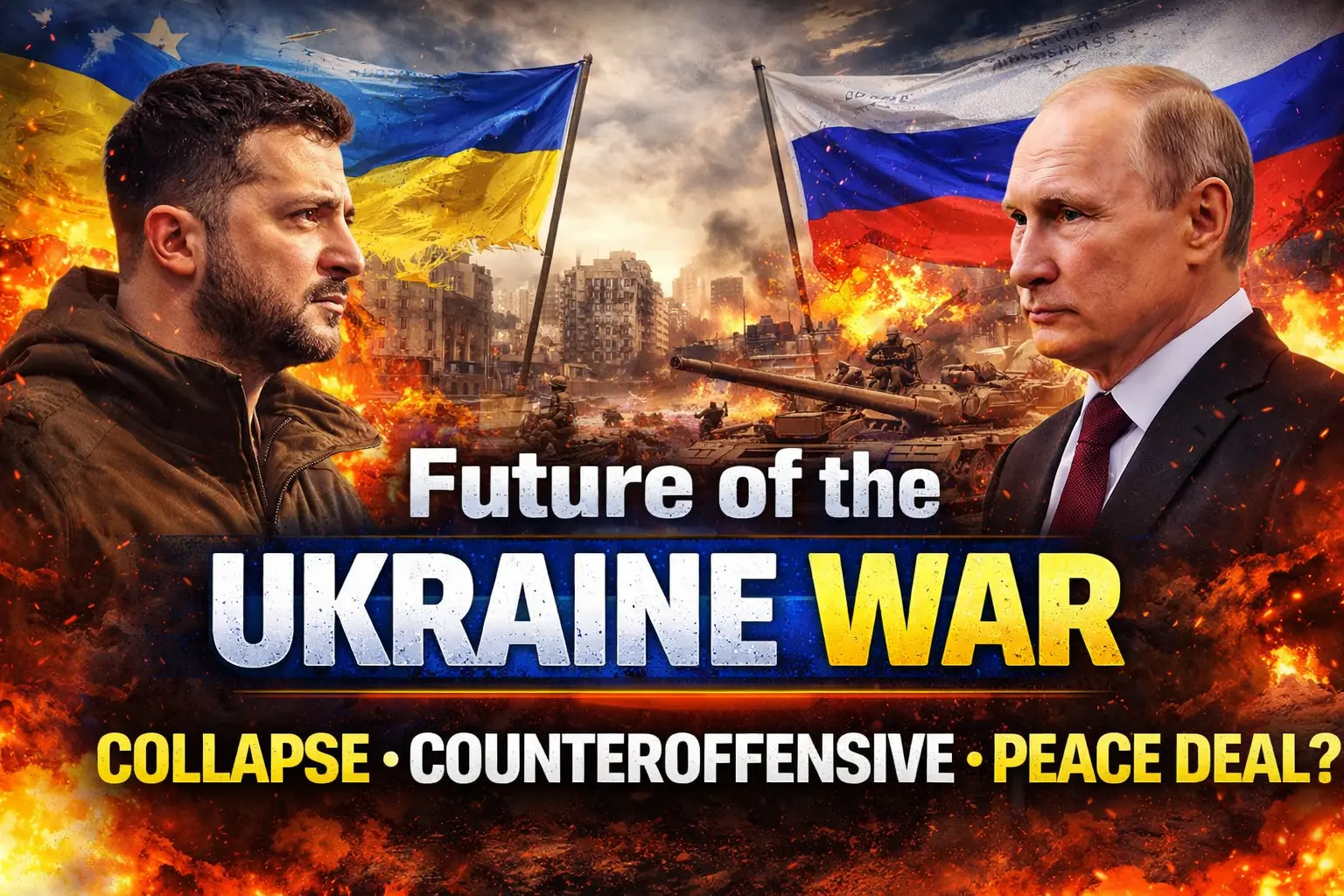
The war in Ukraine has entered a phase where clarity is fading and uncertainty is growing. What once appeared as a fast-moving conflict has now transformed into a prolonged war of attrition. Frontlines are relatively static, resources are stretched, and global attention is slowly shifting.
The real question now is no longer who is winning today. It is what happens next.
Will Ukraine regain momentum and launch a decisive counteroffensive, or is the country heading toward exhaustion and eventual compromise? Could diplomacy finally step in, or are we witnessing the slow shaping of a frozen conflict?
This article breaks down the current battlefield realities, strategic options, and the most likely scenarios ahead.
Current Battlefield Reality: A War of Attrition
The war today is not about rapid advances. It is about endurance.
- Heavy artillery exchanges dominate the battlefield
- Both sides are suffering manpower and equipment losses
- Infrastructure damage continues to weaken Ukraine’s economy
- Russia is focusing on grinding down Ukrainian defenses
Ukraine has shown resilience, but the cost is rising. Russia, despite setbacks, has adapted its strategy toward long-term pressure.
This is no longer a war of movement. It is a war of survival.
Ukraine’s Position: Strengths and Limitations
Strengths
- Strong Western support in weapons and intelligence
- High morale and national unity
- Experience in modern combat and adaptability
Limitations
- Dependence on external military aid
- Limited manpower compared to Russia
- Economic strain due to prolonged war
Ukraine’s biggest advantage is international backing. Its biggest weakness is that this support is not guaranteed forever.
Russia’s Strategy: Slow Pressure, Long Game
Russia has shifted from rapid offensives to a more calculated approach.
- Continuous pressure on multiple fronts
- Targeting energy infrastructure
- Expanding defense lines in occupied territories
Russia is not in a hurry. Its strategy is based on exhaustion.
The longer the war continues, the more pressure Ukraine faces internally and externally.
The Role of NATO and the West
Western support has been critical, but cracks are beginning to appear.
Key Challenges
- War fatigue among European populations
- Political divisions in the United States
- Concerns over escalating into a wider conflict
Reality
The West wants Ukraine to survive, but not at the cost of a direct war with Russia.
This creates a delicate balance. Support continues, but with limits.
Three Possible Future Scenarios
1. Ukrainian Counteroffensive Success
In this scenario, Ukraine regains momentum.
- Advanced weapons systems change battlefield dynamics
- Strategic breakthroughs weaken Russian positions
- Ukraine reclaims key territories
Reality Check
This requires sustained Western support and significant operational success. It is possible, but increasingly difficult.
2. Prolonged Stalemate and Frozen Conflict
This is currently the most likely outcome.
- Frontlines stabilize with minor changes
- Neither side achieves decisive victory
- Conflict turns into a long-term standoff
What It Means
- Ukraine remains partially occupied
- Russia consolidates control in captured areas
- Tension continues for years
This scenario resembles other long-term conflicts where resolution remains distant.
3. Negotiated Peace Settlement
A political solution emerges through negotiation.
- Ceasefire agreements are reached
- Territorial compromises may be considered
- Security guarantees become central
Challenges
- Ukraine does not want to concede territory
- Russia wants recognition of its gains
- Trust between both sides is extremely low
Diplomacy is possible, but only when both sides feel they have no better option.
What Could Trigger a Major Shift?
Several factors could change the direction of the war.
1. Change in Western Support
If military aid decreases significantly, Ukraine’s position weakens rapidly.
2. Internal Pressure in Russia
Economic or political instability inside Russia could impact its war strategy.
3. Battlefield Breakthrough
A sudden, decisive military success by either side could reshape negotiations.
4. Expansion of the Conflict
If NATO becomes directly involved, the war could escalate dramatically.
Global Impact of the Ukraine War
This conflict is not limited to Eastern Europe.
Economic Effects
- Energy markets remain unstable
- Food supply chains are affected globally
Security Implications
- NATO expansion and military spending have increased
- Other regions are watching closely and adjusting strategies
Geopolitical Consequences
- Strengthening of Russia–China relations
- Growing divide between Western and non-Western blocs
What Happens Next? A Realistic Outlook
Looking ahead, the most realistic scenario is neither victory nor collapse.
Instead, we are likely to see:
- Continued fighting with limited territorial changes
- Increased pressure for negotiations behind the scenes
- Gradual shift toward a frozen conflict
Ukraine will continue to resist. Russia will continue to apply pressure.
But both sides are approaching limits.
Key Takeaways
- The war has entered a prolonged, exhausting phase
- A decisive victory for either side is unlikely in the short term
- Western support remains the key factor for Ukraine
- A frozen conflict is becoming increasingly probable
FAQs
1. Can Ukraine win the war completely?
A complete victory is difficult but not impossible. It depends heavily on sustained Western military support and battlefield success.
2. Why hasn’t Russia ended the war quickly?
Russia underestimated Ukraine initially and has now shifted to a long-term strategy focused on attrition.
3. Is peace likely in 2026?
Peace is possible but unlikely without major changes on the battlefield or political pressure on both sides.
4. What is a frozen conflict?
It is a situation where active fighting decreases, but no formal peace agreement is reached, leaving tensions unresolved.
Conclusion
The Ukraine war is no longer about rapid victories or dramatic breakthroughs. It has become a test of endurance, strategy, and patience.
The coming months will not bring easy answers. Instead, they will reveal how much each side is willing to endure and what compromises they are prepared to accept.
The future of this war will likely be decided not by a single battle, but by a gradual shift in momentum, resources, and political will.
And that is what makes this conflict so unpredictable.
It is not just a war on the battlefield. It is a war of time.