Every candidate aspiring to join the Pakistan Army hears about Officer-Like Qualities (OLQs). However, very few truly understand what ISSB means by them.
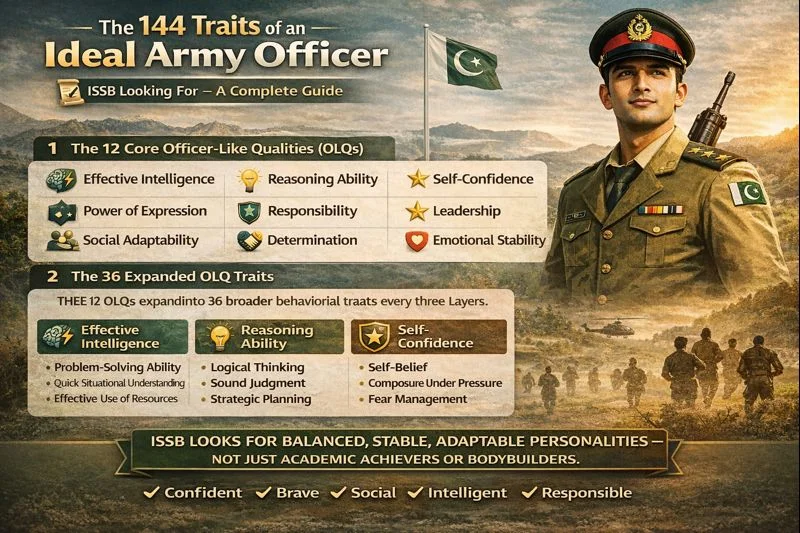
ISSB does not select bodybuilders, toppers, or mechanically perfect individuals. Instead, it looks for balanced, stable, and adaptable personalities who demonstrate the potential to grow into military officers.
To evaluate this potential, ISSB breaks personality assessment into three layers:
-
12 Core Officer-Like Qualities (OLQs)
-
36 Expanded Behavioral Traits
-
144 Micro-Level Personality Indicators
These traits are observed continuously — through psychological tests, group tasks, interviews, communication style, social interaction, leadership behavior, and even everyday conduct.
This guide explains what ISSB actually looks for and how OLQs are assessed in real time.
Section 1: The 12 Core Officer-Like Qualities (OLQs)
The following twelve qualities form the foundation of ISSB assessment:
-
Effective Intelligence
-
Reasoning Ability
-
Power of Expression
-
Self-Confidence
-
Initiative
-
Courage
-
Responsibility
-
Social Adaptability
-
Cooperation
-
Leadership
-
Determination
-
Emotional Stability
Each of these is not judged in isolation. ISSB evaluates how these qualities appear naturally and consistently across different situations.
Section 2: The 36 Expanded OLQ Traits
Each core OLQ expands into three broader behavioral traits, creating a structured framework of 36 qualities.
1. Effective Intelligence
-
Problem-solving ability
-
Quick situational understanding
-
Effective use of available resources
2. Reasoning Ability
-
Logical thinking
-
Sound judgment
-
Strategic planning
3. Power of Expression
-
Clear communication
-
Confident delivery
-
Controlled body language
4. Self-Confidence
-
Self-belief
-
Composure under pressure
-
Fear management
5. Initiative
-
Proactiveness
-
Creativity
-
Willingness to take the first step
6. Courage
-
Physical courage
-
Moral courage
-
Logical risk-taking
7. Responsibility
-
Accountability
-
Discipline
-
Reliability
8. Social Adaptability
-
Polite behavior
-
Adjustment under stress
-
Ability to work with diverse individuals
9. Cooperation
-
Team spirit
-
Helping attitude
-
Ego control
10. Leadership
-
Influence over others
-
Direction-setting
-
Motivation
11. Determination
-
Consistency
-
Strong work ethic
-
Commitment
12. Emotional Stability
-
Anger control
-
Fear control
-
Stress management
These traits form the behavioral blueprint of an officer.
Section 3: The 144 Micro-Traits of an Ideal Officer
ISSB does not “tick boxes.” Instead, it observes micro-behaviors that reflect deeper personality traits. These 144 indicators are grouped under the 12 OLQs.
Below is a summarized structure showing how ISSB observes them:
Effective Intelligence (12 Indicators)
-
Quick thinking
-
Practical decision-making
-
Flexibility
-
Creative problem-solving
-
Task prioritization
-
Realistic assessment
Reasoning Ability (12 Indicators)
-
Logical conclusions
-
Analytical thinking
-
Balanced judgment
-
Structured thought process
-
Emotional neutrality
Power of Expression (12 Indicators)
-
Clear speech
-
Logical explanation
-
Eye contact
-
Confidence
-
Respectful communication
Self-Confidence (12 Indicators)
-
Calmness
-
Humility
-
Trust in decisions
-
Recovery after setbacks
-
Controlled ego
Initiative (12 Indicators)
-
Volunteering
-
Taking charge
-
Offering solutions
-
Self-motivation
-
Acting at the right time
Courage (12 Indicators)
-
Calmness under pressure
-
Moral strength
-
Physical boldness
-
Mental toughness
-
Willingness to sacrifice
Responsibility (12 Indicators)
-
Discipline
-
Punctuality
-
Honesty
-
Ethical judgment
-
Reliability
Social Adaptability (12 Indicators)
-
Patience
-
Conflict handling
-
Respect for diversity
-
Positive interaction
Cooperation (12 Indicators)
-
Team orientation
-
Supporting others
-
Sharing credit
-
Respecting group decisions
ISSB evaluates these indicators collectively, not individually.
Section 4: How ISSB Assesses OLQs in Real Time
1. Psychological Tests
-
Word Association Test (WAT): subconscious thinking
-
Sentence Completion: emotional stability
-
Picture Story Writing: leadership, judgment, and decision-making
-
Personality profiling: internal consistency
2. GTO Tasks
-
Group Discussions: expression and confidence
-
Group Planning: intelligence and reasoning
-
Outdoor Tasks: courage and teamwork
-
Command Task: leadership
-
Final Tasks: cooperation and group orientation
3. Interview
-
Personal background questions → maturity and responsibility
-
Stress questions → emotional control
-
Opinion-based questions → reasoning ability
-
Counter-questions → presence of mind
ISSB focuses on consistency across situations, not perfection in one task.
Conclusion: What ISSB Truly Wants
The 144 OLQ indicators combine to create a complete personality profile. ISSB looks for candidates who are:
-
Confident, but not arrogant
-
Brave, but not reckless
-
Social, but not dominating
-
Intelligent, but not over-clever
-
Responsible, but not mechanical
There is no single “perfect type.” ISSB selects candidates whose personality shows balance, realism, and officer potential.
This guide provides a clear and accurate framework of what ISSB is actually assessing — beyond myths and assumptions.