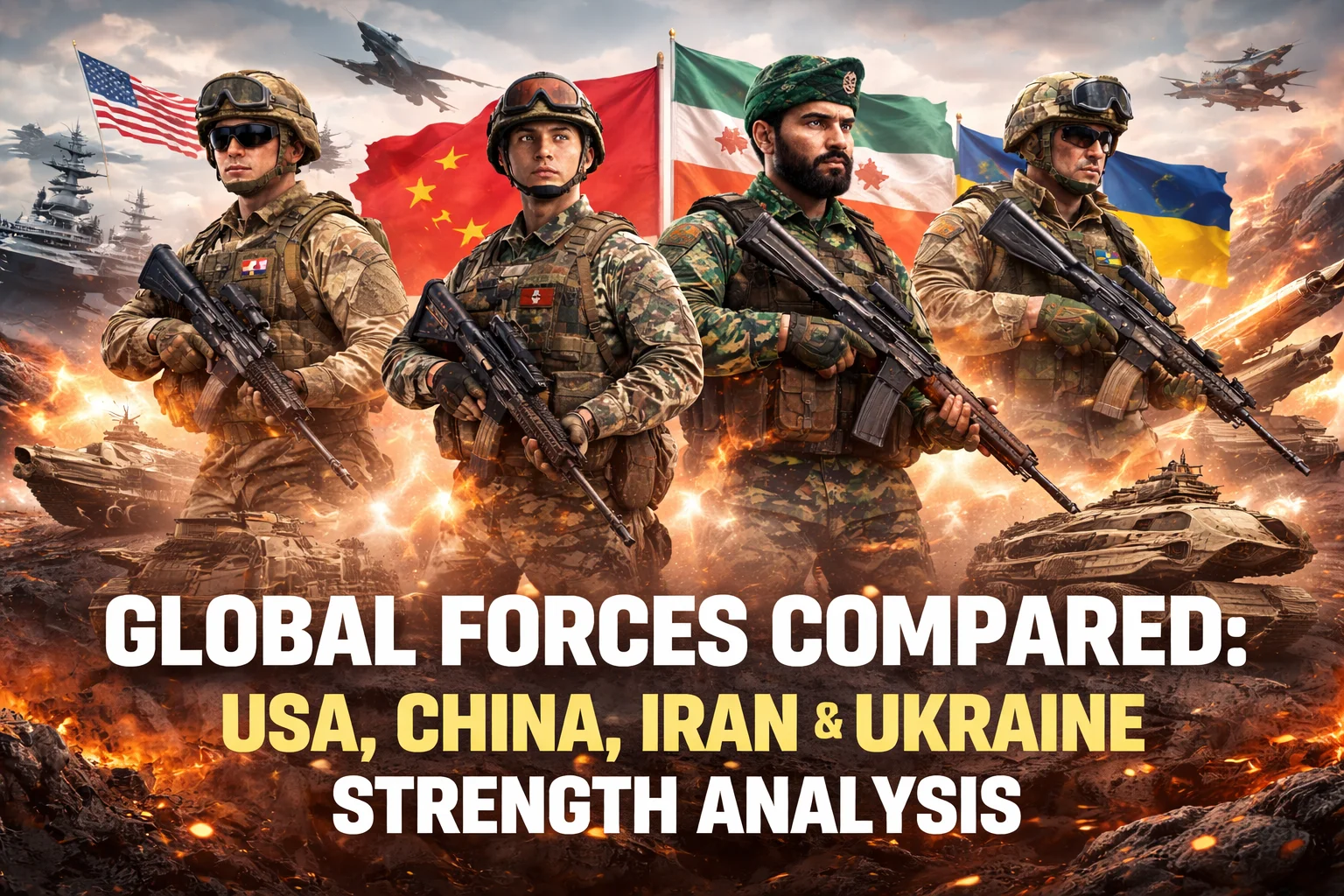
In recent years, conversations around military strength have become more intense and more complex. It’s no longer just about who has the biggest army, it’s about who can adapt faster, think smarter, and respond in real time. When we look at countries like the USA, China, Iran, and Ukraine, we’re not just comparing weapons we’re comparing mindsets, strategies, and real-world performance.
This isn’t a simple ranking. It’s a deeper look at how each force operates and what truly makes them strong in today’s unpredictable world.
Understanding Modern Military Strength
If someone asked this question 20 years ago, the answer would be simple: more tanks, more soldiers, more power. But in 2026, things have changed.
Today, military strength depends on:
- Smart warfare systems
- Real-time intelligence and surveillance
- Drone and unmanned operations
- Cyber capabilities
- Speed of decision-making
A modern army must think as fast as it fights. That’s where the real difference begins.
USA Military: Precision, Power, and Global Reach
The United States military still operates at a level that others are trying to match. What makes it unique is not just its size or budget it’s the integration of everything into one powerful system.
From advanced fighter jets to global satellite networks, the U.S. military functions like a well-connected machine. Every branch Army, Navy, Air Force, and Space operations together.
Another key strength is global reach. The U.S. doesn’t just defend its borders; it can project power anywhere in the world within hours.
Real thought: The U.S. military feels less like a traditional army and more like a high-tech system that happens to fight wars. That difference is huge.
China Military: Fast Growth with Strategic Focus
China is building its military with a clear vision: long-term dominance. It may not openly say it, but its actions show a strong focus on becoming the top global power.
One area where China stands out is naval expansion. Its growing fleet is designed to control key sea routes. At the same time, it’s investing heavily in missile systems, artificial intelligence, and cyber warfare.
However, there’s one honest limitation lack of real combat testing in recent years.
Real thought: China is preparing for future wars, not past ones. But preparation and reality are two different things.
Iran Military: Strategy Over Strength
Iran doesn’t compete directly with superpowers in terms of technology or budget. Instead, it uses a completely different approach—strategic resistance.
Its focus is on:
- Missile development
- Guerrilla-style tactics
- Regional alliances and influence
- Defensive warfare
Iran’s strength lies in making conflict difficult and costly for its opponents.
Real thought: Iran understands its position. Instead of trying to be the strongest, it focuses on being the hardest to defeat.
Ukraine Military: The Power of Experience
Ukraine has gained something that cannot be bought or built overnight real battlefield experience. Its forces have been tested under extreme pressure, adapting quickly to modern warfare conditions.
What makes Ukraine stand out:
- Effective use of drones
- Strong coordination with Western systems
- High morale and motivation
- Tactical flexibility
This is a force that learns in real time and improves fast.
Real thought: Ukraine proves that modern war is not just about power t’s about how quickly you can adjust when things go wrong.
Direct Comparison: Different Strengths, Different Roles
Each of these countries operates in a different way:
- USA dominates globally with advanced systems
- China focuses on future dominance and expansion
- Iran controls its region through strategy
- Ukraine excels in active battlefield conditions
There’s no single winner in every situation. It depends on the type of conflict.
Trending Military Strategies in 2026
The battlefield is evolving fast. Some key trends shaping modern forces include:
- Increased use of autonomous drones
- Cyber warfare becoming a frontline tool
- Real-time satellite intelligence
- Smaller, more flexible combat units
- Information warfare and psychological tactics
These trends are changing how wars are fought—and who wins them.
FAQs
1. Which military is most advanced right now?
The United States leads in overall technology and global capability.
2. Is China catching up to the USA?
Yes, especially in naval and missile technology, but it still has ground to cover.
3. Why is Ukraine gaining attention globally?
Because of its real combat experience and rapid adaptation in modern warfare.
4. What makes Iran different from other forces?
Its focus on asymmetric warfare and regional strategy rather than global dominance.
5. What will future wars look like?
More digital, faster, and less dependent on traditional large-scale battles.
Conclusion
Looking at these four forces side by side, one thing becomes clear—modern military power is not one-dimensional. The United States remains the strongest overall, China is building for the future, Iran plays a smart defensive game, and Ukraine shows the value of real-world experience.
If you step back and think about it, the real shift isn’t just in power—it’s in how power is used. Speed, intelligence, and adaptability now matter more than numbers alone.
From a human perspective, the strongest military today is not just the one with the most weapons—it’s the one that understands the modern battlefield better than anyone else.