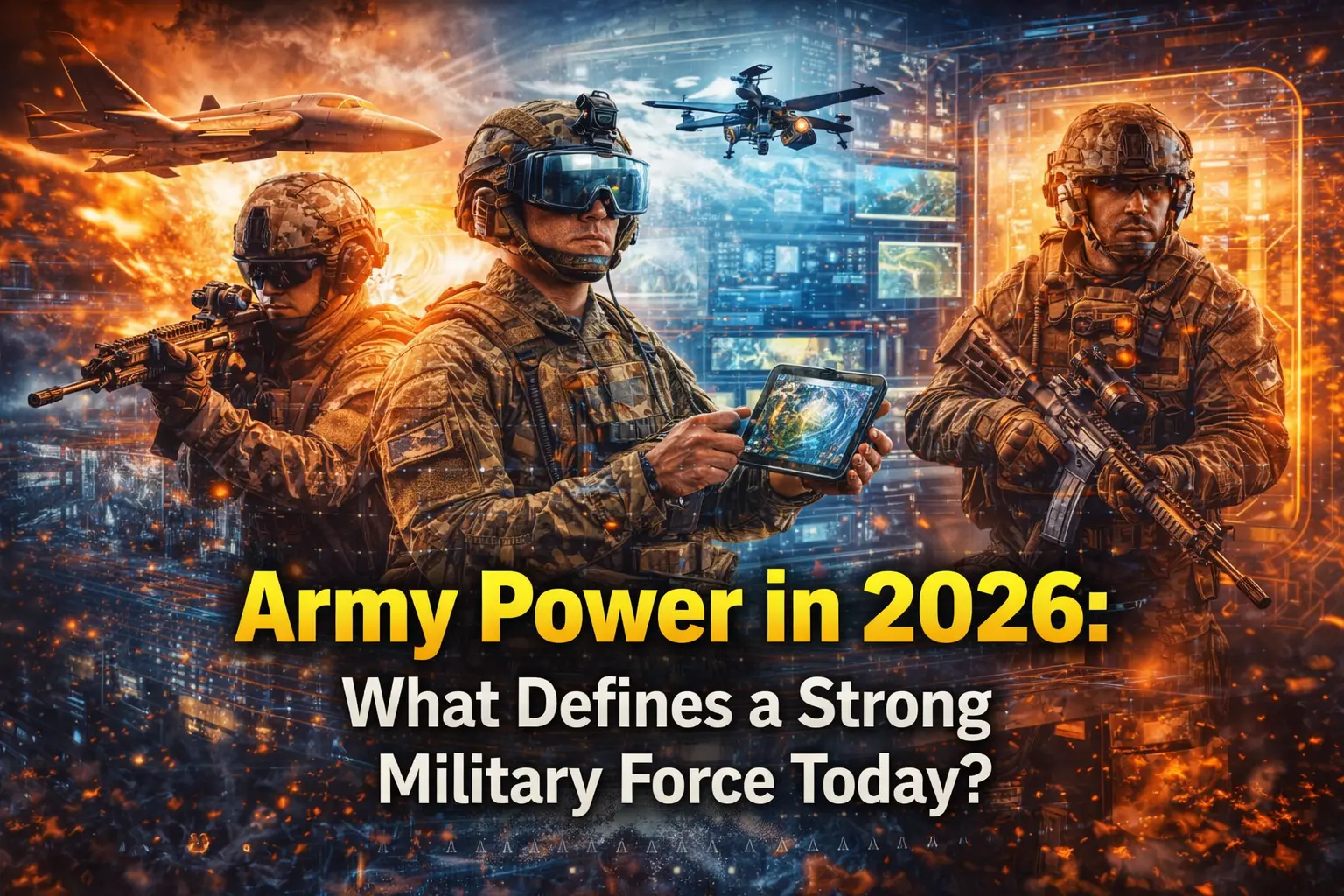
In today’s world, the idea of a “strong army” has changed completely. It is no longer just about the number of soldiers, tanks, or fighter jets. Power is now defined by a combination of technology, strategy, training, and the ability to respond quickly to any threat.
In 2026, military strength is not just visible on the battlefield. It exists in data networks, intelligence systems, cyber units, and even in decision-making speed.
So the real question is not who has the biggest army. The real question is who has the smartest, fastest, and most adaptable force.
What Defines Army Power Today
Modern military power is built on multiple layers working together.
1. Technology Superiority
- Advanced weapons systems
- Precision-guided missiles
- Artificial intelligence integration
- Real-time surveillance and intelligence
Technology allows armies to strike faster and more accurately than ever before.
2. Training and Discipline
A well-trained soldier is still the core of any military force.
- Realistic combat training
- Mental toughness and resilience
- Ability to operate in complex environments
Even the best equipment is useless without trained personnel.
3. Speed of Deployment
Modern conflicts require rapid response.
- Quick mobilization of troops
- Airlift and transport capabilities
- Pre-positioned military assets
Speed can decide the outcome before a war even fully begins.
4. Intelligence and Information Control
Information is now a weapon.
- Satellite surveillance
- Electronic intelligence systems
- Cyber intelligence operations
Knowing the enemy’s move before it happens is a major advantage.
The Role of Army in Modern Warfare
Despite the rise of air and naval power, armies still play a central role.
Key Responsibilities
- Holding and controlling territory
- Conducting ground operations
- Stabilizing conflict zones
- Supporting joint operations
Air power can strike, but only ground forces can secure victory.
Modern Army Structure: More Flexible, More Lethal
Today’s armies are no longer rigid formations.
Key Features
- Smaller, highly mobile units
- Special forces with strategic roles
- Integrated communication systems
- Coordination with air and cyber units
Flexibility has replaced size as the key factor.
Firepower vs Strategy: What Matters More?
This is one of the biggest debates in military thinking.
Firepower
- Heavy weapons
- Large-scale destruction capability
- Strong defensive systems
Strategy
- Smart use of resources
- Timing and positioning
- Psychological advantage
Reality
Firepower wins battles. Strategy wins wars.
Global Comparison: Different Approaches to Army Power
Different countries focus on different strengths.
United States
- Technology-driven force
- Global reach and rapid deployment
China
- Large force with growing technological capability
- Focus on regional dominance
Russia
- Strong artillery and missile systems
- Experience in hybrid warfare
Regional Powers
Countries like Turkey, Iran, and India focus on adaptability and regional influence.
Challenges Facing Modern Armies
Even powerful forces face serious challenges.
1. High Cost of Modern Warfare
Maintaining advanced systems requires huge budgets.
2. Cyber Vulnerability
Digital systems can be targeted and disrupted.
3. Long-Term Sustainability
Prolonged conflicts can strain resources and morale.
What Makes an Army Truly Strong
A truly powerful army is not just well-equipped. It is balanced.
Key Qualities
- Strong leadership
- High morale
- Technological edge
- Strategic thinking
- Ability to adapt quickly
Without balance, even powerful armies can struggle.
Future of Army Power: What Comes Next
The future of military strength is already taking shape.
1. AI-Driven Warfare
Faster decision-making and automated systems.
2. Increased Use of Unmanned Systems
Robotics and drones reducing human risk.
3. Data-Centric Operations
Wars fought through information dominance.
What Could Change the Balance of Power
Several factors could shift global military balance.
- Breakthrough in military technology
- Alliances and partnerships
- Economic strength supporting defense budgets
- Internal stability of nations
Power is not static. It constantly evolves.
Key Takeaways
- Army power today is defined by technology, training, and strategy
- Speed and intelligence are critical advantages
- Modern armies are becoming smaller but more effective
- Future wars will depend on adaptability and innovation
FAQs
1. What is the most important factor in modern army power?
A combination of technology, training, and strategy. No single factor is enough.
2. Are large armies still relevant?
Yes, but quality and capability matter more than sheer numbers.
3. How important is technology in warfare?
Extremely important. It provides speed, accuracy, and intelligence advantages.
4. Can smaller countries build strong armies?
Yes, by focusing on technology, training, and smart strategy.
Conclusion
Army power in 2026 is no longer about size alone. It is about capability, coordination, and control.
The strongest armies are those that can think faster, move quicker, and adapt better than their opponents. Technology has changed the battlefield, but the core principle remains the same.
Victory belongs to those who prepare better.
And in today’s world, preparation means more than weapons.
It means understanding the future before it arrives.