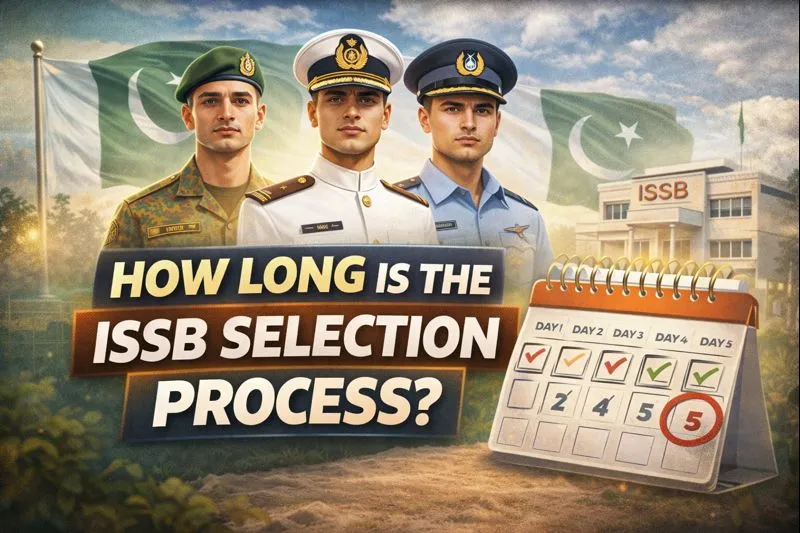
The Inter Services Selection Board (ISSB) selection process is a crucial stage for candidates who wish to join the Pakistan Armed Forces as commissioned officers. While many aspirants focus heavily on preparation, a large number remain confused about the actual duration of the ISSB process and what happens during each phase.
Understanding how long the ISSB selection process takes is important because it helps candidates manage expectations, reduce anxiety, and mentally prepare for the journey ahead. Contrary to some misconceptions, ISSB is not a one-day test. It is a structured, multi-day assessment designed to evaluate a candidate’s personality, leadership potential, mental strength, and suitability for military life.
This article provides a complete, realistic, and easy-to-understand explanation of the ISSB selection timeline, covering what candidates experience from arrival to final results.
Overview of the ISSB Selection Timeline
The core ISSB assessment lasts five consecutive days at an ISSB center. During this period, candidates remain under observation almost continuously. Each day is designed to assess different aspects of personality and behavior.
It is important to distinguish between:
-
ISSB assessment duration (5 days)
-
Overall selection journey (can take several months)
While the ISSB testing itself ends within five days, the final induction into the armed forces depends on medical reviews, merit lists, and training schedules.
Day 1 – Arrival and Screening Process
The first day is commonly referred to as Screening Day, and it plays a decisive role in the ISSB process. On this day, a large number of candidates are assessed in a short time to determine who will proceed further.
What Happens on Day 1?
After reaching the ISSB center, candidates go through:
-
Administrative registration and verification
-
Chest number allotment
-
Photograph and record creation
-
Completion of the Personal Information Questionnaire (PIQ)
The PIQ is extremely important because it becomes a reference document for psychologists, interviewers, and GTOs throughout the remaining days.
Intelligence Tests
Candidates then appear in:
-
Verbal Intelligence Test
-
Non-Verbal Intelligence Test
These tests evaluate logical reasoning, problem-solving ability, and mental alertness. Results are usually announced within 15 to 30 minutes.
Outcome of Screening Day
-
Candidates who pass the intelligence tests stay for the remaining four days
-
Candidates who do not qualify are sent back the same day
For some aspirants, the ISSB process ends on Day 1, while for others, the real assessment begins.
Day 2 – Psychological Assessment Day
The second day is dedicated entirely to psychological evaluation. This day is designed to assess a candidate’s inner personality rather than academic knowledge or physical strength.
Purpose of Psychological Tests
Psychological tests aim to understand:
-
Thinking patterns
-
Emotional stability
-
Decision-making approach
-
Stress response
-
Honesty and consistency
There are no “model answers.” These tests analyze how naturally and realistically a candidate responds.
Common Psychological Tests
On this day, candidates usually attempt:
-
Story writing based on pictures
-
Word response exercises
-
Situation-based reaction tests
-
Self-description writing
Psychologists observe consistency between written responses and information provided in the PIQ. Artificial or memorized answers often work against candidates.
Day 3 – Group Testing Officer (GTO) Activities Begin
The third day introduces candidates to the Group Testing Officer (GTO), who assesses candidates through structured group activities.
Focus of GTO Day
This phase evaluates:
-
Teamwork
-
Leadership ability
-
Communication skills
-
Confidence and initiative
-
Cooperation under pressure
Typical Activities on Day 3
Activities may include:
-
Group discussions
-
Planning exercises
-
Initial group tasks
Candidates are observed not only on what they say, but also on how they listen, support others, and behave in a group environment.
Day 4 – Advanced GTO Tasks and Individual Performance
The fourth day continues GTO assessments and places more emphasis on individual responsibility and physical confidence.
Key Activities on Day 4
Candidates may take part in:
-
Progressive group tasks
-
Half group tasks
-
Command tasks
-
Individual obstacles
-
Final group task
The command task is particularly important because it allows the GTO to observe leadership style, decision-making, and confidence when placed in charge.
Physical fitness is observed, but extraordinary athletic ability is not mandatory. The focus remains on effort, courage, and teamwork.
Day 5 – Conference and Final Decision
The fifth and final day is known as Conference Day. This is when the assessment process concludes.
What Happens on Conference Day?
-
Candidates appear before a panel of senior officers
-
Performance from all previous days is reviewed collectively
-
Short questions may be asked
-
Final decision is announced
The conference is not a new test. Instead, it is a concluding discussion based on the candidate’s overall performance.
Results Announcement
Candidates are informed whether they are:
-
Recommended
-
Not recommended
This marks the end of the five-day ISSB assessment.
Is ISSB Always Exactly Five Days?
Yes, the standard ISSB assessment process is five days long. However, not all candidates experience the full five days because:
-
Some are screened out on Day 1
-
Others complete the full assessment
The structure remains the same across ISSB centers, although minor scheduling differences may exist.
What Happens After the ISSB Process Ends?
Recommendation at ISSB does not mean immediate joining. After ISSB:
-
Medical evaluations may be reviewed
-
Final merit lists are prepared
-
Candidates wait for call letters
This post-ISSB phase can take several weeks or months, depending on service requirements and available slots.
Why ISSB Uses a Multi-Day Selection Process
ISSB spreads assessments over several days to avoid judging candidates based on a single performance. This allows evaluators to:
-
Observe consistency in behavior
-
Detect artificial personalities
-
Evaluate leadership under different conditions
-
Assess adaptability over time
This approach ensures that selected candidates possess genuine qualities suitable for military life.
Common Misconceptions About ISSB Duration
Many candidates believe:
-
ISSB is a one-day interview
-
Recommendation guarantees joining
-
Conference day is extremely difficult
In reality:
-
ISSB is a structured five-day evaluation
-
Recommendation only means eligibility
-
Conference day is a review, not a trap
Understanding these facts helps reduce unnecessary stress.
How Candidates Should Approach the ISSB Days
Candidates should focus on:
-
Remaining natural and confident
-
Communicating clearly and respectfully
-
Cooperating with group members
-
Staying mentally and physically balanced
Trying to “act” like an officer often leads to inconsistency, which evaluators can easily detect.
Does ISSB Duration Change for Different Entries?
The duration of the ISSB assessment remains the same for all entries, including:
-
PMA Long Course
-
Short Service Commission
-
Graduate courses
Only pre-ISSB procedures differ, not the core five-day assessment.
Final Thoughts on ISSB Selection Duration
The ISSB selection process is a five-day residential assessment designed to evaluate a candidate’s overall personality rather than academic knowledge alone. Each day has a specific purpose, and together they form a comprehensive evaluation system.
While the assessment itself is short, the impact of those five days can shape a candidate’s future career. Understanding the duration and structure allows aspirants to prepare realistically and perform with confidence.