Many students in Pakistan dream of joining the Pakistan Army, Navy, or Air Force. One of the biggest concerns candidates have is whether their eyesight is good enough to pass the Inter-Services Selection Board (ISSB) medical examination. Some students worry that wearing glasses will automatically disqualify them, while others believe that only perfect natural vision is accepted.
The reality is that eyesight rules depend on the branch and role you are applying for. This guide explains the eyesight standards in clear and simple language so you know exactly what is required before you apply.
Understanding the Role of ISSB in Selection
The ISSB is responsible for selecting suitable candidates for officer-level positions in the Pakistan Armed Forces. Selection is not based on academics alone. Instead, candidates are assessed through personality testing, psychological analysis, group exercises, interviews, and a final medical examination.
Medical suitability is an essential part of the process. The Armed Forces require individuals who are healthy and capable of handling demanding responsibilities. Eyesight is therefore evaluated carefully during the medical stage.
Why Eyesight Matters in Defence Services
Good eyesight supports:
-
Effective observation during training and operations
-
Accuracy in reading instruments and instructions
-
Safety during outdoor field activities
-
Better performance in physically demanding environments
However, not every role requires perfect natural vision. Many candidates serving today wear glasses and perform successfully in their careers. What matters most is whether your eyesight can meet the minimum medical standard for your chosen branch.
General Eyesight Requirement for ISSB Candidates
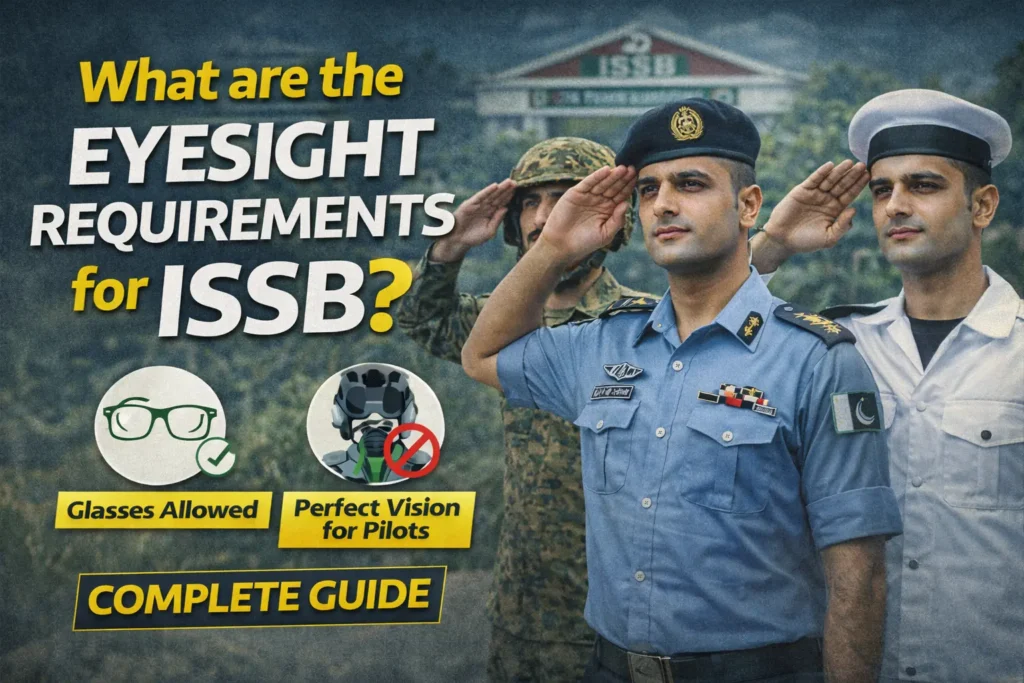
For most ground branches of the Pakistan Army, Pakistan Navy, and Pakistan Air Force (non-flying roles), the general requirement is:
Your eyesight must be correctable to 6/6 with glasses or contact lenses.
This means:
-
You may have weak eyesight
-
You may already be using prescription glasses
-
You may still be medically fit if vision becomes normal after correction
So wearing glasses does not automatically make you ineligible. What matters is whether your eyesight can be restored to normal clarity. If glasses correct your vision to 6/6, you are generally acceptable for standard roles.
Stricter Eyesight Requirements for Flying and Aviation Roles
Some specialist branches require perfect natural (unaided) eyesight. These include:
-
Pakistan Air Force General Duty Pilot (GDP)
-
Army Aviation pilot roles
-
Certain naval aviation categories
These positions require rapid visual reactions, depth judgement, and precision during flight. Because of these safety-critical factors, candidates for flying roles normally must have:
6/6 vision without glasses or lenses.
If you wear glasses, you are usually not eligible for pilot training programs. However, you may still apply for other officer categories.
Eyesight and Colour Vision Tests
During medical assessment, colour perception is also evaluated. Colour blindness may limit eligibility for certain operational roles, aviation branches, or technical trades where colour signals are important. In some non-operational categories, minor colour vision difficulty may still be acceptable, depending on the nature of service.
Every candidate’s case is reviewed individually during medical evaluation.
What If You Have Weak Eyesight?
Weak eyesight alone is not a problem for most officer-level ground branches, provided that:
-
Your eyesight can be corrected to 6/6 with glasses
-
You do not suffer from serious eye disease
-
Your eye pressure and retina are normal
-
You pass all other medical tests
However, if your eyesight remains below standard even after correction, your eligibility may be affected.
It is therefore important to have your eyes tested by a qualified specialist before applying. This prevents unpleasant surprises during the medical stage.
Laser Eye Surgery and ISSB Eligibility
Some candidates choose laser eye surgery (such as LASIK) before applying. While such candidates are not automatically rejected, each case is examined carefully.
Doctors will check:
-
Stability of eyesight after surgery
-
Corneal condition
-
Healing and recovery status
-
Long-term safety of vision
Final approval is made during the Combined Military Hospital (CMH) medical examination.
Candidates should never undergo surgery solely for passing ISSB without professional medical advice. Consultation with an ophthalmologist is strongly recommended.
What Happens During the ISSB Medical Eye Examination?
Candidates undergo a detailed examination that may include:
-
Visual acuity measurement
-
Eye muscle coordination testing
-
Colour vision testing
-
Depth perception evaluation
-
Internal and external eye checkup
The purpose of these tests is to ensure that candidates are medically safe to perform future duties in stressful and demanding environments.
Eyesight Requirements Are Not the Only Selection Factor
Medical fitness is just one part of ISSB assessment. Candidates are also evaluated on:
-
Intelligence and problem-solving ability
-
Leadership and initiative
-
Social interaction and communication
-
Character and responsibility
-
Confidence and discipline
-
Adaptability and teamwork
A strong personality, honesty, and a positive attitude play a major role in success. Many candidates with glasses go on to become outstanding officers.
How Candidates Can Take Care of Their Eyesight
Although eyesight is largely genetic, good habits can support long-term eye health. These include:
-
Visiting an eye specialist regularly
-
Wearing prescribed glasses consistently
-
Avoiding excessive screen exposure
-
Using proper lighting while reading
-
Getting adequate rest and hydration
-
Maintaining a healthy, balanced diet
Avoid self-prescribed contact lenses or unverified treatment methods. Always rely on qualified medical advice.
Common Myths About ISSB Eyesight Rules
There are many misunderstandings among students. Some common myths include:
Myth 1: Wearing glasses means automatic rejection
Reality: Glasses are allowed for most ground roles.
Myth 2: Only pilots undergo eyesight checks
Reality: All candidates undergo medical assessment.
Myth 3: Laser surgery guarantees selection
Reality: Eligibility still depends on medical approval.
Myth 4: Weak eyesight means you should not apply
Reality: Correctable vision is usually acceptable.
Understanding the actual standards helps candidates prepare confidently.
Summary of Eyesight Requirements
| Role Type | Eyesight Requirement |
|---|---|
| Army, Navy, and PAF Ground Roles | Correctable to 6/6 (glasses allowed) |
| Flying and Aviation Roles | 6/6 unaided (no glasses) |
| LASIK Candidates | Case-by-case review |
| Colour Blind Candidates | Restricted in operational and aviation roles |
Standards may vary slightly depending on course type and intake policy.
Additional Preparation Tips for ISSB
While medical fitness is important, candidates should focus on overall readiness. Useful preparation areas include:
-
Strengthening English communication skills
-
Building self-confidence
-
Staying physically active
-
Developing leadership habits
-
Keeping general knowledge updated
-
Practicing time-management skills
Balanced personality development is highly encouraged.
Is weak eyesight a problem for ISSB?
Weak eyesight is usually acceptable as long as it can be corrected to 6/6 using glasses or lenses for ground branches. Aviation roles require perfect unaided vision.
Can I join the Armed Forces if I wear glasses?
Yes. Many officers wear glasses. You must, however, meet the required medical standards during your examination.
Does laser eye surgery guarantee eligibility?
No. Candidates who have undergone surgery are examined individually, and approval depends on final medical fitness.
Is colour blindness allowed in ISSB?
Colour blindness may limit entry into some operational and aviation trades. Eligibility depends on the course and policy at the time.
Do eyesight rules change over time?
Policies may be updated occasionally. Candidates should always refer to the latest information from official Armed Forces recruitment portals.
Conclusion
Eyesight standards at ISSB are designed to ensure that candidates are medically capable of serving in demanding environments. For most officer categories in the Army, Navy, and Air Force, eyesight that can be corrected to 6/6 with glasses is acceptable. Only specialist aviation roles require perfect unaided vision.
This means that many students who wear glasses still remain fully eligible to pursue their dream of serving Pakistan. Candidates should focus on maintaining good health, preparing mentally and physically, and building a strong, confident personality. ISSB does not judge eyesight alone; it evaluates the whole person and their potential to become a responsible future leader.
For the most accurate and updated information, applicants should always review official recruitment guidelines before applying.