If you want to join the Pakistan Armed Forces as a Commissioned Officer, one of the most important stages in your selection journey is the Inter Services Selection Board (ISSB). Many candidates ask the same question:
“Who is eligible to appear in ISSB?”
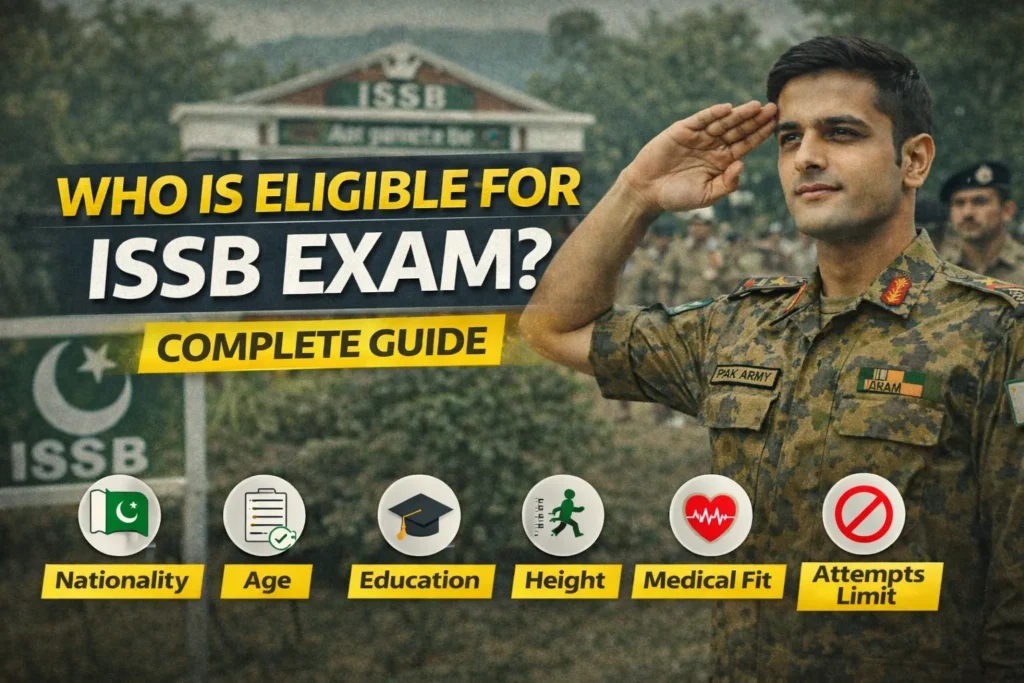
In this detailed guide, we will explain the eligibility criteria for candidates applying through Pakistan Army, Navy and Air Force officer entry programs. This article covers age limits, education requirements, physical standards, medical fitness rules, attempts allowed, and important conditions every candidate must know — in simple language.
What is ISSB?
ISSB stands for Inter Services Selection Board. It is the psychological and personality assessment stage used to select future officers for:
-
Pakistan Army
-
Pakistan Navy
-
Pakistan Air Force
Candidates who pass initial tests are invited for a 4–5 day assessment, where their leadership qualities, intelligence, physical fitness and personality traits are evaluated.
But only eligible candidates are called — so understanding eligibility is the first and most important step.
Basic Eligibility for ISSB
Although each course has slightly different requirements, the general conditions for appearing in ISSB are:
✅ 1. Nationality
-
Candidate must be a Pakistani citizen
-
Dual nationals must surrender foreign nationality (if required at commission stage)
✅ 2. Gender
-
Both Male and Female candidates are eligible
-
Females apply through specific courses (e.g., AFNS, Lady Cadet Course, PAF GD Pilot Female, etc.)
-
✅ 3. Age Limits
Age varies depending on entry category. Generally:
-
Intermediate / FSC candidates:
17 to 22 years -
Graduates (BA / BSc / BS):
17 to 24 years -
Serving Armed Forces personnel:
Up to 25 years (in most cases)
Age relaxation may apply for specific entries, but official announcements should be followed.
✅ 4. Education Requirements
You must meet minimum academic qualifications:
📌 For PMA Long Course (Army)
-
Intermediate / FSC / A-Level or Equivalent
-
Minimum Marks: 45–55%+ depending on category
-
Pre-engineering, pre-medical, ICS, I.Com and FA students may apply (as per latest policy)
📌 For PAF GD Pilot & Other Courses
-
Intermediate or Bachelor’s Degree
-
Science subjects preferred in some courses
📌 For Pakistan Navy Officer Cadre
-
Intermediate or Bachelor’s
-
Specific subject groups may apply
👉 Note:
Students awaiting results may also be eligible — depending on policy.
✅ 5. Marital Status
-
Most officer courses require candidates to be unmarried
-
Serving personnel may be allowed exceptions
✅ 6. Physical Standards
To appear in ISSB, candidates must meet physical requirements such as:
-
Minimum height (Male): 5 feet 4 inches (approx.)
-
Minimum height (Female): Around 5 feet 2 inches (varies)
-
Weight: According to Body Mass Index (BMI)
Candidates must also be medically fit.
✅ 7. Medical Fitness
Candidates are checked for:
-
Normal eyesight
-
Healthy heart & lungs
-
No major physical disability
-
Normal hearing & speech
-
Mentally stable & emotionally balanced
Any serious medical condition may lead to rejection.
Who Cannot Appear in ISSB? (Important Rules)
ISSB clearly states disqualification criteria. You cannot appear if:
❌ You were twice rejected by ISSB
❌ You were rejected by GHQ / AHQ / NHQ selection boards after ISSB
❌ You were declared permanently unfit by military doctors
❌ You were dismissed or expelled from the Armed Forces or government service
❌ You provided false documents or information
Also:
-
A minimum waiting period applies between two ISSB attempts (usually around 4 months)
-
Candidates cannot appear while undergoing academic board exams or training
How Many Attempts Are Allowed?
Most candidates are allowed:
2 Attempts Only
Once rejected twice by ISSB, you are no longer eligible for officer selection via ISSB.
So preparation is extremely important.
Eligibility by Education Path
Let’s break it down further:
🎯 1. FSC / Intermediate Students
You are eligible if:
✔ You have completed or are completing FSC / FA / ICS / A-Level
✔ You fall within age limits
✔ You meet marks criteria
✔ You pass initial tests
This route usually leads to PMA Long Course, PAF GD Pilot, or Navy officer entry programs.
🎯 2. Bachelor’s Degree Students
Graduates can also apply through:
-
Short Service Commission
-
Lady Cadet Course
-
PAF and Navy entries
Requirements include:
✔ Recognized degree
✔ Minimum marks or CGPA
✔ Age within limit
✔ Physical and medical fitness
🎯 3. Serving Armed Forces Personnel
They may be recommended internally and sent to ISSB through their unit process.
What ISSB Actually Tests
Eligibility makes you qualified to appear — but selection depends on performance.
ISSB judges:
-
Confidence
-
Leadership
-
Honesty
-
Intelligence
-
Communication
-
Discipline
-
Problem solving
-
Emotional stability
Candidates go through:
-
Interviews
-
Group tasks
-
Psychological tests
-
Outdoor tasks
-
Written assessments
Remember — ISSB prefers natural, balanced and responsible personalities.
Documents Required to Appear in ISSB
You usually need to bring:
📄 CNIC / B-Form
📄 Academic Certificates
📄 Domicile
📄 Photographs
📄 ISSB Call Letter
📄 Medical reports (if required)
Key Tips Before Applying
✔ Stay physically fit
✔ Improve English & confidence
✔ Build communication skills
✔ Avoid over-acting — be natural
✔ Maintain discipline and honesty
Final Words
ISSB eligibility is designed to select mentally strong, physically fit and morally disciplined individuals who can lead Pakistan’s Armed Forces with honor. If you meet the required standards and prepare with dedication, you can proudly take your place among future officers.
Your journey begins with eligibility — but success depends on hard work, character and commitment.
Good luck to all future candidates 🇵🇰