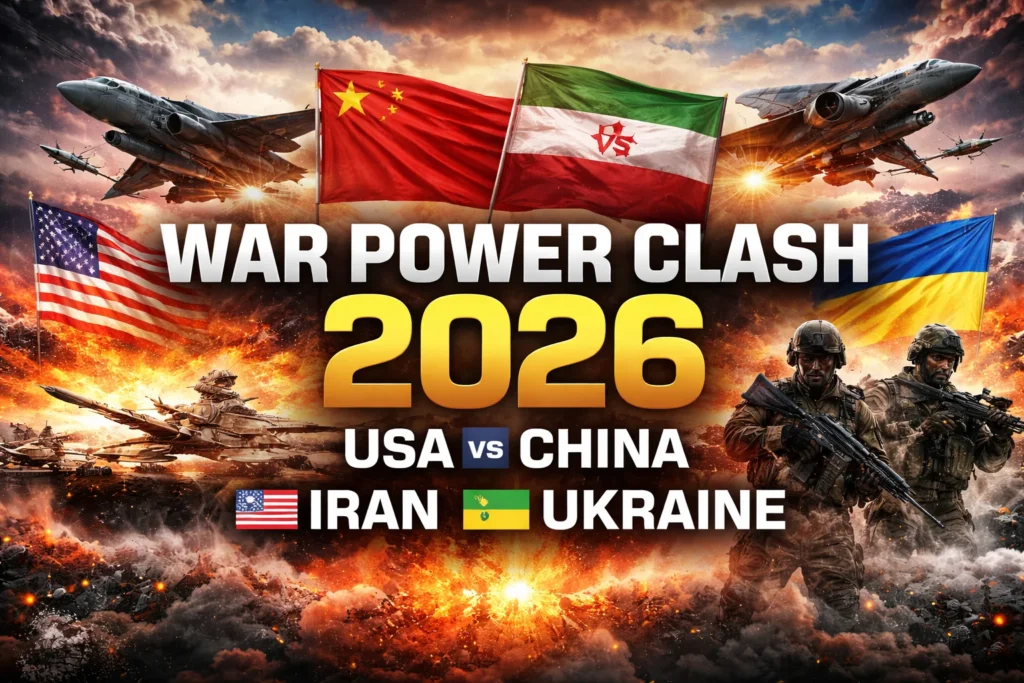
Modern warfare is no longer just about who has the biggest army or the most tanks. The battlefield in 2026 looks completely different from what it did even a decade ago. Today, wars are fought with drones, cyber attacks, satellite intelligence, and precision missiles. A country might have fewer soldiers, yet still dominate if it has advanced technology and strong global alliances. That’s why comparing military power between countries like the USA, China, Iran, and Ukraine requires more than just numbers; it demands a deeper understanding of strategy, innovation, and adaptability.
Take the example of drone warfare. Cheap drones costing a few thousand dollars are now destroying multi-million-dollar military systems. This shift has leveled the playing field for smaller or less-funded nations. The concept of power has transformed from “size” to “smartness.” Countries that adapt quickly to new technologies tend to perform better in real conflicts. This is exactly what we are seeing in ongoing global tensions today.
Conventional vs Asymmetric Warfare
Here’s where things get really interesting. Not all countries fight wars the same way. The USA and China rely heavily on conventional warfare, large armies, air superiority, naval fleets, and high-tech weapons. On the other hand, Iran focuses on asymmetric warfare, which means using unconventional tactics like drones, proxy groups, and surprise attacks.
Recent reports show that Iran has lost a significant portion of its military infrastructure, with over 66% of missile and drone facilities destroyed in recent strikes. Yet, despite this, Iran continues to pose a serious threat using low-cost drones and strategic disruptions like blocking oil routes. This proves that even a weaker military can create massive global impact if it plays smart.
Overview of Global Military Giants
USA Military Strength
The United States remains the world’s most powerful military force in 2026. It ranks #1 globally with unmatched airpower, naval strength, and global reach. According to recent data, the U.S. has over 13,000 aircraft and hundreds of naval assets, including aircraft carriers that can strike anywhere in the world.
What makes the U.S. truly dominant is not just its weapons, but its logistics and global presence. It can deploy troops anywhere within hours, supported by advanced satellites and intelligence systems. However, even this giant is facing challenges in modern warfare, especially against unconventional strategies.
China Military Growth
China is rising fast and not just fast, but aggressively. Ranked #3 globally, China has massively invested in military modernization. It has over 3,500 aircraft and millions of active personnel, along with a rapidly growing nuclear arsenal.
China’s biggest strength is its industrial power and self-reliance. It can produce weapons, ships, and technology domestically without relying on other countries. This gives it long-term sustainability in war. Many experts believe China is the only country that can truly challenge the U.S. on a global scale.
Iran Military Capabilities
Iran might not look strong on paper, but it’s far from weak. Ranked around #16 globally, Iran has a large manpower base and strong missile capabilities.
Its real strength lies in strategy. Iran uses drones, naval mines, and regional influence to disrupt stronger enemies. Even after heavy losses, it continues to attack and maintain pressure in key regions like the Strait of Hormuz. This makes Iran a dangerous opponent, especially in regional conflicts.
Ukraine’s War Experience
Ukraine has proven something powerful: experience matters more than size. Despite having fewer resources, Ukraine has successfully resisted larger forces using smart tactics, Western support, and advanced technology.
Its logistics and battlefield adaptability are among the best right now. According to comparisons, Ukraine excels in logistics and operational efficiency, even if it lacks manpower compared to countries like Iran.
USA vs Iran – A Power Imbalance?
Technology and Air Dominance
On paper, the USA completely dominates Iran. The difference in budget, technology, and equipment is massive. The U.S. controls the skies, seas, and even space-based warfare systems.
But here’s the twist modern wars are not always won on paper.
Iran’s Asymmetric Strategy
Iran plays a different game. Instead of direct confrontation, it uses tactics that drain the enemy over time. Think of it like a smaller boxer dodging punches and slowly exhausting a stronger opponent. Iran’s drones and regional disruptions make wars costly and complicated for the U.S.
China vs USA The Real Superpower Battle
Economic and Military Power
This is the battle everyone is watching. The U.S. leads in military technology, while China leads in manufacturing and rapid expansion. China’s defense spending and infrastructure are growing at an incredible rate.
Nuclear and Naval Strength
The U.S. still leads in nuclear weapons and naval power, but China is closing the gap quickly. With hundreds of nuclear warheads and a growing navy, China is preparing for long-term competition.
Ukraine vs Iran Unexpected Comparison
Logistics vs Manpower
Iran has more manpower, but Ukraine has better logistics and real combat experience. This creates an interesting contrast between quantity and quality.
Real Battlefield Performance
Ukraine has shown strong battlefield performance due to Western support and innovation. Iran, on the other hand, relies on persistence and unconventional tactics.
Key Military Comparison Table (2026)
| Country | Global Rank | Strength Type | Key Advantage | Weakness |
| USA | #1 | Advanced Tech | Air & Naval Power | Expensive warfare |
| China | #3 | Industrial Power | Mass production | Less combat experience |
| Iran | #16 | Asymmetric | Drones & disruption | Outdated tech |
| Ukraine | #20 | Tactical | Real war experience | Limited resources |
Who is Winning the Current War Scenario?
Role of Alliances
No country fights alone anymore. Ukraine is supported by Western nations, while Iran has indirect support from powers like China and Russia.
This makes wars more complex and global.
Hybrid Warfare Impact
Modern war is now a mix of cyber attacks, drones, economic pressure, and propaganda. It’s not just about bombs anymore it’s about controlling information and resources.
Final Verdict Who is the Strongest?
If we talk about pure military power, the USA is still number one. No country matches its global reach, technology, and defense systems.
If we talk about future potential, China is the biggest challenger.
If we talk about strategy and resilience, Iran stands out.
If we talk about real battlefield performance, Ukraine is surprisingly strong.
So, who is the best?
👉 It depends on the type of war.
Conclusion
War in 2026 is not black and white. It’s not about who is stronger it’s about who is smarter, faster, and more adaptable. The USA dominates globally, China is rising rapidly, Iran is unpredictable, and Ukraine is battle-tested. Each country brings a different style to warfare, making it impossible to declare a single “winner” in every scenario. The future of war will likely be decided not by strength alone, but by innovation and alliances.
FAQs
1. Who has the strongest military in 2026?
The United States is still ranked #1 globally due to its advanced technology and global reach.
2. Is China stronger than the USA?
Not yet, but China is rapidly growing and could challenge the U.S. in the future.
3. Why is Iran still dangerous despite weaker technology?
Because of its asymmetric warfare tactics like drones and regional disruption strategies.
4. How strong is Ukraine compared to others?
Ukraine is highly effective due to real combat experience and strong international support.
5. Can a weaker country defeat a stronger one?
Yes, modern warfare shows that strategy and innovation can overcome raw power.