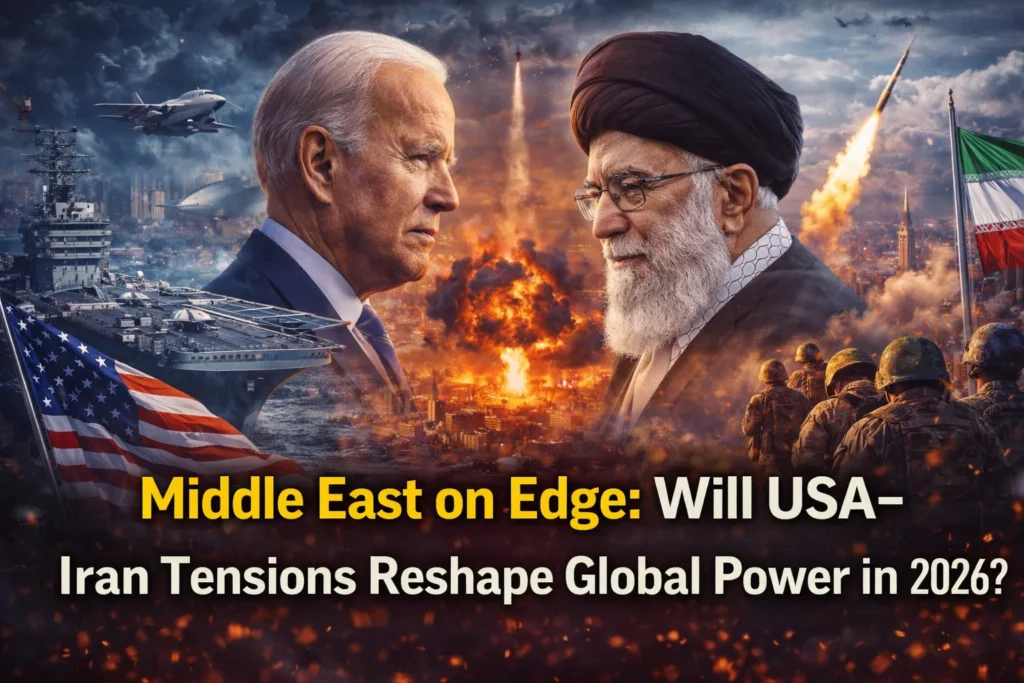
The Middle East is once again at the center of global attention. Tensions between the United States and Iran are rising, military deployments are increasing, and the region feels closer to escalation than it has in years.
But this is not just another geopolitical standoff.
What is unfolding in 2026 has the potential to reshape global power dynamics, impact energy markets, and trigger a chain reaction across multiple regions. The real question is not whether tensions exist. The real question is how far they can go, and what happens next.
Current Situation: Why Tensions Are Rising Again
The situation between the United States and Iran is driven by multiple overlapping factors.
Key Triggers
- Renewed concerns over Iran’s nuclear program
- Increased US military presence in the Middle East
- Attacks by Iran-linked groups on strategic targets
- Growing involvement of regional actors
This is not a single issue. It is a combination of military, political, and strategic tensions all building at once.
Military Posture: Signals from Both Sides
United States Strategy
- Deployment of naval assets in key waterways
- Strengthening air defense systems in allied countries
- Increased surveillance and intelligence operations
The US is signaling readiness without directly engaging.
Iran’s Response
- Expansion of missile and drone capabilities
- Increased naval patrols in the Persian Gulf
- Activation of regional proxy networks
Iran is not matching the US directly. It is applying pressure through indirect means.
The Role of Proxy Forces
One of the most important aspects of this conflict is indirect warfare.
Key Players
- Armed groups in Iraq and Syria
- Houthis affecting Red Sea shipping routes
- Hezbollah’s presence in Lebanon
These groups allow Iran to influence events without entering direct war.
The Strait of Hormuz Factor
This narrow waterway remains one of the most sensitive points in global geopolitics.
Why It Matters
- A significant portion of global oil supply passes through it
- Any disruption can impact global markets instantly
- Military presence in the area is increasing
Even a small incident here can trigger a major escalation.
Global Impact: Beyond the Middle East
This conflict is not limited to one region.
Economic Impact
- Oil prices could rise sharply
- Global inflation pressures may increase
Security Impact
- Increased instability across the Middle East
- Risk of broader regional conflict
Geopolitical Impact
- China and Russia may gain strategic advantage
- Western alliances could face new challenges
Israel’s Role: A Critical Variable
Israel remains a key factor in this equation.
- Strong opposition to Iran’s nuclear ambitions
- Capability to conduct preemptive strikes
- Close coordination with the United States
Any Israeli action could significantly escalate the situation.
What Could Trigger a Direct Conflict
Several scenarios could push the situation beyond control.
Possible Triggers
- Direct attack on US military assets
- Major disruption in global oil routes
- Israeli strike on Iranian facilities
- Miscalculation or accidental escalation
The danger lies not just in intention, but in misjudgment.
What Happens If War Breaks Out
If tensions escalate into open conflict, the consequences would be immediate and global.
Likely Developments
- Missile exchanges across the region
- Attacks on military bases and infrastructure
- Disruption of shipping and trade routes
- Activation of proxy forces across multiple countries
This would not be a localized war. It would be a regional crisis with global effects.
Is Diplomacy Still Possible
Despite rising tensions, diplomatic options still exist.
Challenges
- Deep mistrust between both sides
- Conflicting strategic goals
- Internal political pressures
Opportunities
- Backchannel negotiations
- International mediation
- Economic incentives
Diplomacy is difficult, but not impossible.
What Happens Next: Realistic Scenarios
1. Controlled Tension
- Continued military buildup
- No direct war
- Ongoing proxy conflicts
This is the most likely scenario.
2. Limited Conflict
- Targeted strikes
- Short-term escalation
- Controlled de-escalation
3. Full-Scale War
- Multi-country involvement
- Severe global consequences
This remains the least likely, but most dangerous outcome.
Key Takeaways
- USA–Iran tensions are rising but remain controlled
- Proxy warfare is the main tool of confrontation
- The Strait of Hormuz is a critical flashpoint
- Global impact of any escalation would be significant
FAQs
1. Why are USA and Iran in conflict?
Due to long-standing political, military, and nuclear-related tensions.
2. Can this lead to World War III?
Unlikely directly, but it could trigger wider regional instability.
3. What is the biggest risk right now?
Miscalculation leading to unintended escalation.
4. How will this affect global economy?
Primarily through oil prices and trade disruptions.
Conclusion
The situation between the United States and Iran in 2026 is not just another regional conflict. It is a strategic standoff with global consequences.
Both sides are showing strength, but also restraint. This balance is fragile.
The coming months will be critical. A single event could either push both sides toward negotiation or drag the region into a conflict that reshapes global power dynamics.
For now, the world is watching.
Because what happens here will not stay here.