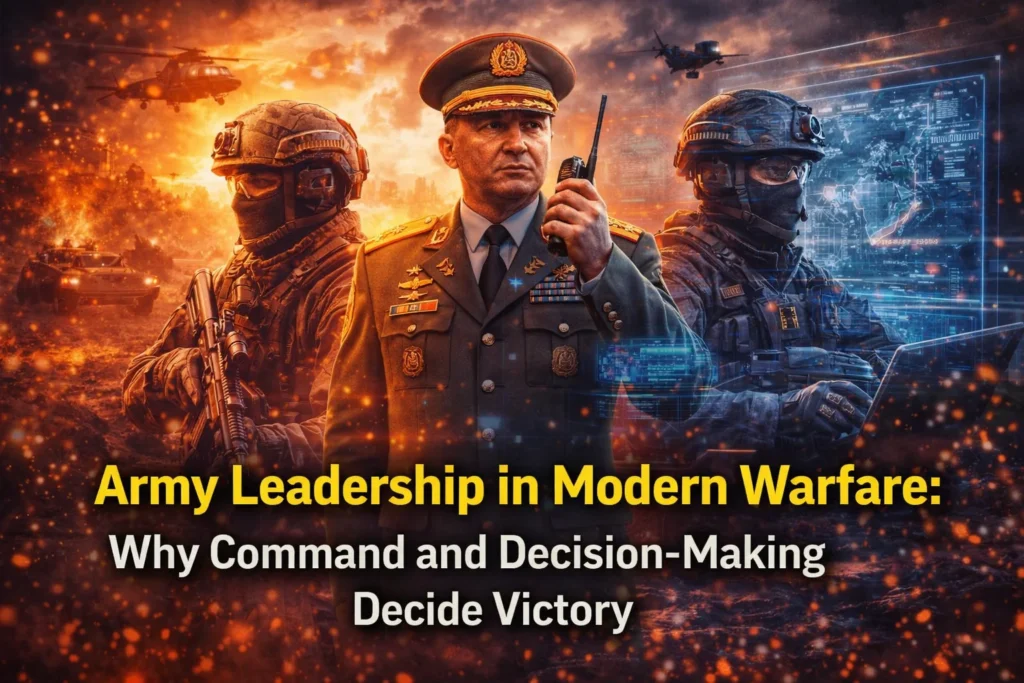
Weapons can destroy. Technology can enhance. But in the end, wars are decided by leadership.
In modern warfare, the role of army leadership has become more critical than ever. The battlefield is no longer simple. It is fast, complex, unpredictable, and often chaotic. In such an environment, the difference between victory and defeat often comes down to one thing. Decision-making.
A strong army without strong leadership is directionless. A smaller force with smart leadership can change the course of a war.
This article explores how modern army leadership works, why it matters more than ever, and what kind of leaders will dominate future battlefields.
The Changing Role of Army Leadership
In the past, leadership was about commanding troops and executing orders. Today, it is much more dynamic.
Modern Leadership Responsibilities
- Making rapid decisions in high-pressure situations
- Managing multi-domain operations
- Integrating intelligence, cyber, and physical forces
- Leading both technology and people
Leaders are no longer just commanders. They are decision-makers, strategists, and coordinators.
Decision-Making Speed: The New Battlefield Advantage
One of the biggest changes in modern warfare is speed.
Why Speed Matters
- Battles unfold in minutes, not days
- Information changes in real time
- Delayed decisions can lead to immediate losses
A commander who decides faster often gains the upper hand before the enemy reacts.
Leadership Under Pressure: The Real Test
War is unpredictable. Plans rarely go exactly as expected.
Key Challenges Leaders Face
- Limited or conflicting information
- Constant pressure from multiple fronts
- High stakes with no margin for error
The ability to stay calm and make clear decisions under pressure defines great leaders.
The Balance Between Strategy and Execution
Leadership is not just about planning. It is about execution.
Strategy
- Long-term vision
- Understanding the enemy
- Resource management
Execution
- Real-time decision-making
- Adjusting plans on the battlefield
- Leading troops in action
A good strategy without execution fails. Strong execution without strategy lacks direction.
Technology and Leadership: A New Relationship
Technology has changed how leaders operate.
Key Changes
- Real-time battlefield data
- AI-assisted decision-making tools
- Communication across multiple units instantly
While technology provides information, the final decision still depends on the leader.
Leadership at Different Levels
Modern armies rely on leadership at every level.
Strategic Level
- National and military leadership planning overall operations
Operational Level
- Commanders managing campaigns and large-scale movements
Tactical Level
- Officers leading units on the ground
Each level must work in coordination for success.
Qualities of a Strong Military Leader
1. Clarity of Thought
Ability to understand complex situations quickly.
2. Adaptability
Changing plans when conditions shift.
3. Confidence
Making decisions even in uncertainty.
4. Communication
Clearly conveying orders and intent.
5. Responsibility
Taking ownership of decisions and outcomes.
Leadership vs Technology: Who Wins?
A key question in modern warfare.
Reality
- Technology supports leadership
- It does not replace it
Even with AI and automation, human judgment remains critical.
Real Battlefield Impact of Leadership
History and modern conflicts show a clear pattern.
- Strong leadership can turn defensive positions into victories
- Poor leadership can waste superior resources
- Morale of troops depends heavily on leadership
Leadership directly affects outcomes on the ground.
Future of Army Leadership
The next generation of military leaders will need new skills.
Key Trends
- Understanding technology and AI systems
- Leading in multi-domain environments
- Managing information overload
- Making faster, smarter decisions
The future leader will be part commander, part analyst, and part strategist.
What Could Go Wrong Without Strong Leadership
Risks
- Confusion and miscommunication
- Poor coordination between units
- Slow or incorrect decisions
- Loss of morale
Even the strongest army can fail without effective leadership.
Key Takeaways
- Leadership is the most critical factor in modern warfare
- Decision-making speed can determine victory
- Technology supports but does not replace leaders
- Future leaders must adapt to complex, fast-changing environments
FAQs
1. Why is leadership important in the army?
Because leaders make decisions that guide the entire force and determine outcomes.
2. Can technology replace military leaders?
No, technology assists but cannot replace human judgment and experience.
3. What is the most important skill for a military leader?
The ability to make clear decisions under pressure.
4. Does leadership affect soldier performance?
Yes, strong leadership boosts morale and effectiveness.
Conclusion
In modern warfare, leadership is not just a role. It is the foundation of success.
Weapons, technology, and numbers all matter, but without strong leadership, they lose their effectiveness. The battlefield is becoming faster and more complex, and only those who can think clearly, decide quickly, and adapt continuously will succeed.
The future of warfare will not just be shaped by machines or weapons.
It will be shaped by the minds that control them.
And in that battle, leadership remains the ultimate advantage.